Poetry Submission Strategy: Whatever works for you

litzinesI have a poetry group that meets once a month at a pizza shop. We’ve been going there for years, so the servers know us well enough to get our drinks without asking what we want.
While most of what we do at these gatherings is workshop our poems, we usually spend the first thirty minutes updating each other on our writing news, sharing our rejections and acceptances and general po-biz chat.

One thing that comes up from time to time is the issue of choosing publications to submit to. There are just so many, and many of them our really good, that sometimes you feel you spend more time just staring at the computer deciding between Well-Dressed Newt Review and Writer’s Tears Journal—and then you don’t send anywhere.

So, here are a couple culling strategies that I and my friends practice.

First and foremost, read a lot of journals, both online and in print. Read them, know them, understand their tastes or trends. If you’re targeting print journals, then subscribe or buy single copies as much as you can. In my writing group we all regularly bring in journals to share, so that spreads the cost around a bit. The easiest and smartest thing is to look for journals that publish works you like. If you don’t like what they publish, but just like the pub’s reputation, then you’re wasting both your time and the editor’s time.

Above all, you need to think about the editors’ and journal’s needs, not yours. While most editors care deeply about literature and are generous with the time they give to writers and their publication, their primary interest is in their journal, not your work. Give them work that fits their journal–don’t expect a publication to change its editorial passions just because you believe your revisioning of Gilgamesh as a cyborg trash compactor is the next big thing. If you write pastoral sonnets, don’t send them to a pub that wants metamodern supernatural erasure poems.

If I find some poems I like in a journal, and I think my work is of equal quality or similar style, I look in the contributor section to see where else that person has published. This has worked pretty well for me, and since I’ve been doing this I’ve noticed my work is turning up more frequently in the same places as works by people I like. It’s a kind of poetry stalking, but in a non-creepy way.

Similar to the above method, if I like a piece in a journal, and see that author is also the editor of another journal, I’ll make a note to check out their pub. Often that writer’s own journal publishes more works I like, so I’ll send them a pack—and maybe mention that I read the editor’s poem in X journal.

I do the same thing with books—when I read a book I really like, I’ll turn to the acknowledgments page to see where the poems first appeared, and usually I’ll pick out a few I think I’d have a chance in.

I keep a list of my top tier journals (the ones that are probably a reach, but worth trying anyway) and will send to those once a year or so. Last year I scored one of those, and this year another (after lots of rejections). My top tier journals may not be yours. For instance, I’ve never sent to The New Yorker, The Paris Review or Tin House, even though I’d be thrilled to appear there, I’m also realistic.

Paying for submissions is a tricky subject, and one I’ve talked about in previous posts, but in the past couple of years I’ve done it more frequently. I don’t like it, but it’s the state of the world now. Of the last 12 places I’ve sent to, three required a $3 submission fee. If a journal offers a buy-an-issue or subscribe alternative to the fee, I’ll take that, even though it cost more, because at least then I know I’m getting something, and it feels less like I’m paying for rejection.

Finally, don’t be afraid to go back to places that already published you. A publication likes developing relationships with its authors—just don’t move the relationship too fast. If it’s an annual or twice yearly pub, I wait two or three years. If it’s monthly, once a year is fine.

Volume also counts—the more you send, the more you’ll publish. I try to keep at least 20 packs of poems circulating at one time, more if I can, and I’ll send a pack out within a day or so of it coming back (unless I’ve decided to work on the poems some more). I also will send the same pack to three places at the same time (and I’m very prompt about notifying the other pubs if I need to withdraw something).

Finally, when you do get something published, help the publisher out by promoting it–share the link on Facebook and Twitter. Send a thank you email or tweet. Post pictures of it. Be proud. If you get rejected–and of course you’ll get rejected–don’t be a jerk about it. That NEVER makes things better.

If you have a strategy that works for you, share it in the comments. If you’re a journal editor, and any of these ideas seem insane, also share that. And if you’re Kevin Young and want to invite me to submit to The New Yorker, hit me up at @uniambic

Is Truth in Poetry Important?

poet_sake (2)

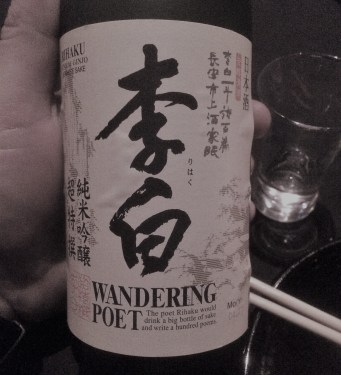
A very good bottle of sake I recently enjoyed with some friends. It has nothing to do with this post.

About a week ago the website Change Seven published an interview with me, conducted by writer Curtis Smith. The interview mostly focused on my book of poems, The Magician’s Handbook, that was released by PS Book in October. One question, however, asked about my writing process, and one part of my answer concerns a topic that’s important to me, so I’m going to elaborate here.

I stated in the interview that I often make up or exaggerate situations or events in my poems. I don’t think that’s a revolutionary concept, but sometimes it still leads to raised questions and sometimes raised eyebrows.

Truth, in poetry, is a complicated issue. I cringe when I hear poets talk about how they’re writing the truth or getting at the truth or whatever truthiness idea they go on about. Maybe that’s because I equate truth with facts, and in world where anything a person doesn’t agree with is branded as fake news, truth can be difficult.

Rather than aiming for truth in my poems, I aim for real or authentic (again, a vague and unhelpful word, sorry). Do the situations in the poem feel real, does it move or affect the way real feels move or affect. There’s a sort of truth, I suppose, in all my poems, and many of them do include autobiographical references, but rarely are they completely loyal to the events or people referenced. Because a poem is written in the first person doesn’t mean that it’s naturally about my experience or that the experience happened the way it’s depicted in the poem. It’s always bothered me that a short story is assumed to be fiction (in part because that’s how we’ve come to compartmentalize the genres) while poems are not. The fact that “creative non-fiction” is its own genre kind of baffles me.

Rather than sticking to the facts, my loyalty in writing is to the language—the way it sounds, the response it makes in my gut, the pictures it draws in the head and the places it steers me.

I raise this point because I think it’s important that poets feel free to create, not report. I’ve had students resist following the language out of fear of not properly reporting the facts.

I’ve had people ask me, usually after readings, about specific things in poems, and sometimes they’re disappointed if I tell them part of it was made up. I’ve burned down buildings, broken up with girlfriends, lived in towns, and killed off family members, all that didn’t exist. Every time I publish a book I’ve had to explain to my parents (who are still alive, despite what one of my poems says) not to take it too seriously.

Of course I’m guilty of the fallacy of autobiography too. In being moved by every Philip Levine poem about a factory, I have to remind myself that he didn’t, in fact, work for 40 years in every auto plant in Detroit, however it might seem that way.

Anyway, this is at the top of my mind now because my next book (which is due out this month) includes a section drawn on a group of people who are incredibly close to my heart, yet, out of necessity, are semi-fictional. It’s a series of poems set in the 1980s and describes my sort-of reckless teenage years. Names are changed, events are changed, though there’s a realness to it all that’s important. The three or four recurring characters in those poems are mash ups of about ten different people, as are the stories they act in. It’s easier for me to write that way, and allows me to be loyal to the language, which is what’s really more important for the poetry.

Book Review: Brazil, Indiana by Brian Beatty

brazilindianaWhen I dug into Brian Beatty’s new poetry book, Brazil, Indiana, I was in the middle of season 2 of Twin Peaks (I liked season 1 better), so it’s probably no surprise that I spotted some of the same small town surrealism in Beatty’s book-length poem as is found in Peaks. There’s a man who trains moths, a man who half buried an old truck to spend days sitting in it, a town giant and of course a crazy cat lady.

These are some of the characters that populated the Midwest Beatty grew up in, and he’s populated his book with their stories, as well as, presumably, his own stories, in about 100 short 12-line untitled poems. Each poem is a vignette, some just a little more than anecdotes while others read like psychological profiles of people and locations.

I should note before I go further that I’m not an unbiased reader. I knew Beatty from our MFA years in Bowling Green University, and I have a short blurb on the back of his book. I’ve been reading these poems for years as Brian and I emailed our work to each other. In that time I’ve developed a deep admiration for his insight, talent and discipline to the craft.

About that craft–Beatty’s images strike the critical balance of being both familiar (especially if you’ve lived in a small town) and new. There’s the surreal quality I mentioned earlier, though not the surrealism of Breton, but more the surrealism of Simic, where the real world provides enough weirdness that the author doesn’t have to invent it. There’s the examples I mentioned in the beginning of this post, and many others, such as the kid with Tourette’s who slept under the counter at a burger joint, a beauty queen who wielded butcher knives, and a mayor who kept old circus animals. These people and their stories are used as doorways into a shielded world, one where the gears that kept an old town going are slowly disintegrating, and now the inner workings are starting to show through.

And then there’s the insights that will be familiar to every person who’s been around a farming community:

Every barn at some point becomes

nothing more than a metaphor with a roof

and a door straining against

its last hinge, like this old farmer bent

down to repair the truck tire flat in front

of the only world he’s ever known.

As noted earlier, the poems, are all composed of twelve lines, though the line length and number of stanzas varies throughout. A frequent strategy of his is to work the poem like a Jenga puzzle, stacking images together and then pulling out a key piece at the end to undermine or change it. Just as an image or situation is fresh in your mind, he pulls out a piece to dismantle your first impression. The technique has a way of keeping you alert to shifts and changes, like the weather is constantly on the move, which in his Midwest of memory, it probably was.

While each poem is meant to be read as a part of the book-length work, each stands on its own, and many have appeared individually in journals, though it does benefit from being read in order. The poems build on each other, especially as a few of the characters, notably the main speaker and his family, recur throughout the work. The settings and subjects of Brazil, Indiana will appeal to readers from the Midwest or small towns anywhere, while the technique and quality will appeal to any reader who appreciates surprise, manipulation and lyric story telling.

Interview with Obama Inaugural Poet Richard Blanco

richard-blanco_bccc_nov2016About two weeks after the 2016 presidential election, poet Richard Blanco came to Bucks County Community College for a reading to kick off the college’s Many Voices, Many Stories writing conference. Before the reading, Blanco and I sat down in a little stone cottage on campus to discuss the role of poetry in society, his own writing process, and some of the challenges facing people who enjoy the craft.  Read the complete interview at Cleaver here.

Essay on Associative Poetry

“The discontinuity of the associative mode is an aesthetic response to the frenetic, anti-hierarchical experience of postmodernity, an experience in which the human psyche, assaulted by cable news and News Feeds, Twitter and text messages, suffers from a kind of perpetual attention-deficit disorder, leaping about, as these poems do, from one perception to the next.”  by Christopher Kempf in vol 64 issue 2 of Shenandoah (direct to essay). Here for the full issue.

And inside you’ll find this gem:

“When this balance is lost, when association shades into dissociation and a poem’s allusions seem too anarchistic, the poem becomes self-indulgent, its allusions a kind of private reference or inside joke to which the reader is not privy. Dissociative poetry—a term which characterizes much of our contemporary writing—brands itself as mysterious, postmodern, or playful when in fact such poetry tends more toward obfuscation, clumsily executed and, at worst, devoid of meaning. “Cute and empty” Mehigan calls this poetry; “privileging the arty over art itself,” says Phillips.”