Philadelphia Stories Reviews Necessary Myths

I was thrilled to check into Facebook this morning and see that Philadelphia Stories magazine had posted a new review of my book Necessary Myths. In the review Peter Baroth says:

Clauser is a master of wordcraft. There is a kind of late afternoon buzz quality to his descriptions of nature – even in PSSummerCoverits impermanence. I can definitely see the sun setting on so much of what he describes where we can find such things as “a gossiping spring between rocks…” (“The Children Discover a Spring Between Rocks”). And also perhaps, ever so vaguely, there is a yearning for a terribly remote and tenuous unfallen past. A garden that was probably already beginning to petrify moments after its creation.

Read the entire review here.

On twitter @uniambic

12 Books: A Poetry Nerd’s Poetics Reading List

I recently finished up leading a poetry workshop at a writers’ retreat at Rosemont College near Philadelphia. During one of the classes, populated mostly by MFA graduate students, I brought in a pile of craft/theory/poetics/rant books. I’m a nerd for books about poetry and interviews with poets (I always turn to the interview section first when a new issue of Rattle arrives). Aside from reading lots and lots of poetry, one of the best ways for me to learn more about poetry is through reading poets talk about their own processes and ideas. Here’s a partial list of books I think should be on every poet’s shelf. I’m offering this list here for the retreat students who didn’t get to write down the names of all the titles they were interested in.

Please add more books in the comments section if you think I’ve left out something important or interesting. There’s no particular order of importance in the way I’ve assembled this list, and I may add more as I find things on my shelves.

Writing Poems by Robert Wallace. Harper Collins.
I came to this, as I do with a lot of craft books, first as a fan of Wallace’s own poetry. This book is an excellent hardcore treatise in the basic principles and how they work within poems. Lots of samples and some writing prompts.

Proofs & Theories: Essays on Poetry by Louise Gluck. Ecco.
Here’s a book I love to argue with, which makes the process of reading it fun (and why my copy is so full of scribbled notations). Gluck’s book mixes essays on composition theory with comments of specific poets (Eliot, Oppen, Kunitz). The essay I marked up most is “Against Sincerity.”

Poetry in Person, Twenty-five Years of Conversation with American Poets Edited by Alexander Neubauer. Knopf.
This book is mesmerizing. In it you find 23 transcripts of poets talking with teacher Pearl London and her creative writing classes. These aren’t just any poets though—we get to eavesdrop on Maxine Kumin, Robert Hass, Philip Levine, Galway Kinnell, Lucille Clifton, Li-Young Lee, Charles Simic…

The Poet’s Companion: A Guide to the Pleasures of Writing Poetry by Kim Addonizio and Dorianne Laux. Norton.
This is a very practical and easy to love book on craft. It’s designed more for people who are new to writing poetry, but it also has plenty of insights for established writers. It would make a great textbook for a creative writing class. Lots of prompts and examples are provided. Engagingly written.

Nine Gates: Entering the Mind of Poetry Essays by Jane Hirshfield. Harper Perennial.
I first came to this book, 1) as a fan of Jane Hirshfield’s poems and 2) because I was looking for new ways to think about nature poetry, and Hirshfield suggest I read her essay Two Secrets which is collected here. This book is a mix of theory, craft and philosophy—particularly zen.

The Sound of Poetry by Robert Pinsky. FSG.
Here’s a book that really tries to bring back respect for sound and texture in poetry. Good information, but ironically it’s a bit of a flat read.

Best Words, Best Order by Stephen Dobyns. St. Martins Press.
This should be required on every new MFA student’s shelf. I particularly like chapter 5: Pacing: The Way a Poem Moves.

The Triggering Town by Richard Hugo. Norton.
Any fan of Richard Hugo’s poems probably already knows about this book. On one level it’s a guide on how to write like Richard Hugo, but it’s much more than that. For the beginning poet, he makes poetry less intimidating and more personal, but for the mature writer, there will also be a lot of shared “ah ha” moments. Get this book.

Lofty Dogmas: Poets of Poetics. edited by Deborah Brown, Annie Finch and Maxine Kumin.
This is one of my favorites, and I’d love to teach a class with this as the text book. It compiles essays from ancient times (Horace) to contemporary poets, discussing issues of inspiration, craft and poetry culture. Many of the most important essays on poetry are all wedged in here.

Close Calls with Nonsense: Reading New Poetry Essays by Stephanie Burt. Graywolf.
This collection, all republished from literary journals, attempts to explain and support the work of what Burt calls the elliptical poets—poets like Rae Armantrout, CD Wright, John Ashbery, Lorine Niedecker and others. Often, for me, the support Burt uses doesn’t hold up, but I appreciate it nonetheless. If you’re a fan on this kind of poetry, you’ll find a lot to like here. If you’re not a fan, this book will at least help you understand what they’re trying to do.

The Art of Syntax: Rhythm of Thought, Rhythm of Song by Ellen Bryant Voight. Graywolf.
There are (I think) seven volumes in The Art of series. Of the five I have, this one is my favorite. It offers clear explanations of how sound and texture affect poetry. My other favorite in the series it Dean Young’s The Art of Recklessness.

Poet Bill Knott has Died

A few sources on the internet have reported that Bill Knott passed away Mach 12 due to complications from heart surgery.

Death

by Bill Knott

Going to sleep, I cross my hands on my chest.

They will place my hands like this.

It will look as though I am flying into myself.

__________________________________

Here’s a selection of links to articles, interviews and other Bill Knott info:

Bill Knott’s blog about poetry rejection (includes scan of many rejection slips and letters).

Article on HTML Giant about his selected poems, which was to be published by FSG but he later gave it away for free as a download.

Richard Hell on Bill Knott

Bill Knott was also a painter. Here are some of his painting.

BookSlut interview with Bill Knott in which he calls Basil Bunting’s Briggflats his least favorite poem.

A Wikipedia entry that says almost nothing

A quite lengthy and interesting article on Bill Knott by John Cotter

An interview with Bill Knott on Memorious in which he talks a lot about publishing and rejection.

Something from The Rumpus

Thomas Lux is a big fan of Bill Knott


___

Follow on Twitter @uniambic

Interview with Grant Clauser about Necessary Myths

Here’s an Interview at ITMOAW in which I talk about myths, my relationship with readers and other things I’ll regret.

mwittle's avatarInside the Mind of a Writer

I was lucky enough to meet poet Grant Clauser at the Push to Publish event this past October. I grabbed his book, The Trouble With Rivers, and knew I had to interview him.

Below is the interview:

WITTLE: What books are you reading right now?

CLAUSER: The most recent poetry books would be Richard Carr’s Lucifer (sort of a novel in poetry form—he tells the story of a drug-addled guy who’s stuck with Lucifer hanging on his shoulder all the time); Mary Biddinger’s O Holy Insurgency (I just started this one last night); Brian Russell’s The Year of What Now (awesome—you must get this book); and James Galvin’s Resurrection Update (this is a collected poems from 1998 I think. He’s a very outdoorsy writer, which is something l like a lot).

WITTLE: Who has influenced your current writing style the most and how?

CLAUSER: Influencing my writing and influencing…

View original post 1,686 more words

Book Review: Say Luck by Hayden Saunier

sayluckfrontcover

Of the many complements I could pay to Hayden Saunier’s second poetry collection, Say Luck,  the one that comes to mind first is that it’s fun. While there are poems of grief, doubt and anguish, those are balanced with poems of wit and awareness that ring out with gratitude for life. This ultimately is what makes the collection feel authentic and trustworthy. It’s so seldom that one can say that about a book of poems these days.

The first poem, which is also the title poem of the book, is one of my favorites. It’s in some way a reprimand for self-pity even though “Love walks down the road and death waits at the river.” and an accounting for what’s important in life—it’s a lesson in perspective:

Since you are alive and have leisure enough to read poems

I’d say luck has entered your life more than once.

The strength of Saunier’s poetry is her ability so see, to say, almost what should be obvious to us, but often isn’t. “So much goes unnoticed,” she says. The tone, diction and syntax are largely conversational even when more formal elements are used. The approach eases the reader into the poem, as if she’s letting you in on something. Usually that something comes out of a moment of illumination or discovery, as in the poem “How It Happens, Sometimes”, where an encounter with a stranger stirs a memory of the speaker’s lost mother. Other times those moments are of self-awareness “—ah yes, / you recognize your landscape now.”

A tactic Saunier is very good at is smoothly moving from, or I should say within, an image and into those moments of awareness. Sometimes it happens so subtly you hardly see it sneaking up on you, and then, there it is, some wisdom she’s dropped on your lap:

Our arguments blow over,

shake down like leaves,

all sap retracted

but we recognize the danger here:

how lumps of bullet lead

as hard and blunt

as any words we’ve said

remain suspended

            from Living by the Site of a Minor Civil War Engagement 

In passages like the one above, and many others, you see her talent for loaded lines—words and phrases casting two shadows. She moves into those lines easily, and they appear on your horizon like the crest of a hill you’ve been driving toward but didn’t know you’d reached. “The view from here / will always be the view from here, no matter / who is witness.” she writes in a poem about dealing with someone’s death.

By the end of the book, if you’ve read the poems in order, you feel as if you’ve been walked through a life, maybe as a bird sitting on the author’s shoulder, and been invited to share snippets of experience, ordinary moments and epiphanies drawn from them. She observes, catalogs, recollects, questions and offers insights, as good poets do, asking us to pay similar attention to our own surroundings.

You can find Say Luck here at Amazon.

Follow on Twitter @UnIambic

Sense and Instability: Attack of the Hip Non Sequitur

In the current issue (Jan/Feb 2014) of the American Poetry Review, Joy Ladin savages a Matthew Dickman poem in her essay called Emperor of Ice Cream. The point of the exercise wasn’t to beat up on that poem—the poem was just a handy example used to help her make her argument. The essay looks at the current fashion of hip non sequitur sort of poetry—poetry that, in her words, is “sense optional.” See also: Ashbery.

While parsing Dickman’s Bougainvillae, Ladin raises a number of important questions pertinent to poetry today. In coining the term Hip Non Sequitor she’s given a name, or maybe a category title, to much of what is populating the popular poetry journals.

While she never comes out with a clear judgment-making statement, it’s seems clear that she’s more on the side of sense than non sense. In fact, her most damning statement at the end of the essay suggests that the trend to abandon sense in poetry is the reason so many readers have simply abandoned poetry. “As such meaninglessness becomes ever more common in published poetry, readers stop expecting poetic language to have any relation to sense, which means that poets need worry ever less about it.”

So that’s it? We shouldn’t expect much from poems. She suggests that in such poems, the reader’s search for sense, and lack of finding it, “give way to boredom.” Exactly.

The author isn’t arguing, and neither would I, that poems have to mean in the same way as conversational text or other text, such as prose fiction, do. But so often poems seem to be hiding behind a defense that since they don’t need complete sense that they won’t even bother trying. Just throw the words up into the air and see where they land. There’s a serious lack of responsibility going on in that method. On the other hand, some poems prance around in motely, proud of their senselessness, relying on some higher poetic Morse code that only they understand. “It’s meaninglessness masquerading as meaning,” as Ladin writes.

I won’t begrudge any poet the right to write the kind of poem they want to write, but I reserve the right to not care about them. If meaninglessness is the object, I can get that without reading the poem. For me, poetry itself involves a quest for meaning, for connection. Poetry is largely built on metaphor which seeks to connect one thing to the other thing in order to help the poet (and the reader) make sense of the world. That’s the point, or at least a pretty important one. (yes, I’m oversimplifying, but this is just a short bog post after all)

By the way, I happen to like a lot of Matthew Dickman’s poetry. My copy of his book All-American Poem is full of dog-eared pages and underlined passages, but while the Dickman poem in question has some lovely moments, Ladin was spot-on with her overall critique.

Connect and follow on twitter @UnIambic

Book Review: Lucifer by Richard Carr

luciferIt was on a flight to Las Vegas, hell on earth, that I opened up Richard Carr’s latest book of poems Lucifer. Like Vegas, Lucifer is unique, full of sinister and untrustworthy characters, but completely worth the visit.

Lucifer is a story told in a series of 66, mostly short, poems. In the book are four main characters: Lucifer, a parasite (real or metaphorical or both) who clings “like a tick” to the narrator; a sometimes friend Mick the Bastard; and the girlfriend Juliet.

“This is my condition.” the narrator states in the opening poem, and it’s with point-blank language like that that Carr carries the reader through the narrator’s turbulent relationship with his Lucifer and the other people in the book. The narrator is a slacker, a pot-smoking bum who leaches off his girlfriend and takes people for granted. Lucifer is his constant companion, his comforter, his enabler, his co-conspirator, “Lucifer waits for me to wake and feed him. / Half dozing, I give him his due.” That sounds a little like the relationship between a mother and her infant, but no infant has ever had teeth like this.

The relationships in Lucifer frequently shift; alliances and trust are both fluid, yet Lucifer is a constant, though not always dependable companion. Like any addiction or human frailty, Lucifer is there with an answer or an excuse.

“Love rhymes with blood in the language of Hell” says the narrator. Everything that Lucifer touches is tainted, and Carr’s language leads the reader through that hell where “all the TV channels reach the same conclusion” that “Lucifer leads me slowly onward.”

This book is full of loaded lines like those cited above—language that shows the narrator’s internal struggle, his weakness, his failures: “I let everything but hunger slip away.”

Lucifer is an engaging read and one that should first be done in a single sitting (I finished it before the 5-hour flight landed). The momentum of the story requires it.

You can buy Richard Carr’s Lucifer here from Logan House Press

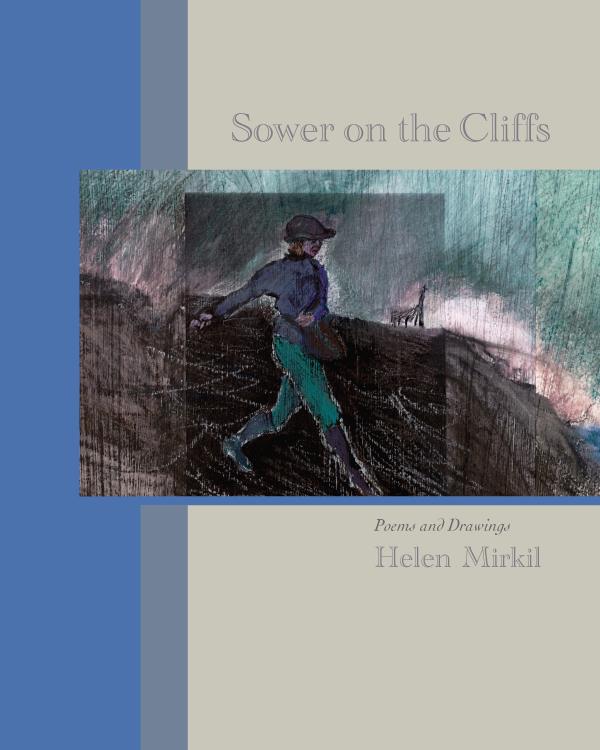
Review of Sower on the Cliffs by Helen Mirkil

Here’s an excerpt of a review I wrote of Helen Mirkil’s new book, Sower on the Cliffs.

Soweronthecliffs_Mirkil

Sower on the Cliffs, Helen Mirkil’s book of poems and original sketches, works on the reader like one of those evening conversations over coffee where catching up with a friend has gone on for hours, yet when it’s time to call it a night, you feel like you’ve just gotten started. That’s because Mirkil’s use of language, mostly direct, gives you a sense of a door opening up before you.
The book is divided into 10 sections, each with only two to four poems bound to a theme. Many of them are family focused, some touch on losses, issues of faith and some tender moments with loved ones. Mirkil leads each section with one of her own sketches.

Like the sketches, black ink outlines, shapes and suggestions of shapes, Mirkil’s poems also follow the less-is-more approach, and that approach yields rewards as well as surprises at times. In poems like “The Station” and “Pressing In,” she offers a few details that act like an invitation for the reader to start making discoveries.

Home again. A knocking

At the screen door,

Parkinson’s. Let it in?

Read the rest of the review here at Philadelphia Stories.


The Great MFA Debate Continues

” Not knowing something is one way to be independent of it – but knowing lots of things is a better way and makes you more independent. It’s exciting and important to reject the great books, but it’s equally exciting and important to be in a conversation with them. ”


From Get a Real Degree by Elif Batuman at The London Review of Books.