I recently wrote a review of the book Convergence: Poetry on the Environmental Impacts of War.
Here’s how it starts:
You can read the whole review at Consequence Forum Substack here.
I recently wrote a review of the book Convergence: Poetry on the Environmental Impacts of War.
Here’s how it starts:
You can read the whole review at Consequence Forum Substack here.
I was thrilled to check into Facebook this morning and see that Philadelphia Stories magazine had posted a new review of my book Necessary Myths. In the review Peter Baroth says:
Clauser is a master of wordcraft. There is a kind of late afternoon buzz quality to his descriptions of nature – even in
its impermanence. I can definitely see the sun setting on so much of what he describes where we can find such things as “a gossiping spring between rocks…” (“The Children Discover a Spring Between Rocks”). And also perhaps, ever so vaguely, there is a yearning for a terribly remote and tenuous unfallen past. A garden that was probably already beginning to petrify moments after its creation.
Read the entire review here.
On twitter @uniambic
The online literary pub Pedestal has published a new review of my book Necessary Myths. I’m flattered and honored by the response.
The reviewer says:
“Throughout Clauser’s book, we encounter this implicit prescription—we must go on with our daily work of being alive, no matter. Like a river, we proceed, sometimes wild, sometimes calm. Clauser gives us that much hope. Reminiscent of the American philosopher Henry Bugbee, he shows us the importance of place, of tasks, and of nature. His poems are imbued with a similar Western-Taoist worldview. It strikes me that Clauser is both old-fashioned and incredibly audacious.”
Find the rest of the review here.
follow on Twitter @uniambic

Of the many complements I could pay to Hayden Saunier’s second poetry collection, Say Luck, the one that comes to mind first is that it’s fun. While there are poems of grief, doubt and anguish, those are balanced with poems of wit and awareness that ring out with gratitude for life. This ultimately is what makes the collection feel authentic and trustworthy. It’s so seldom that one can say that about a book of poems these days.
The first poem, which is also the title poem of the book, is one of my favorites. It’s in some way a reprimand for self-pity even though “Love walks down the road and death waits at the river.” and an accounting for what’s important in life—it’s a lesson in perspective:
Since you are alive and have leisure enough to read poems
I’d say luck has entered your life more than once.
The strength of Saunier’s poetry is her ability so see, to say, almost what should be obvious to us, but often isn’t. “So much goes unnoticed,” she says. The tone, diction and syntax are largely conversational even when more formal elements are used. The approach eases the reader into the poem, as if she’s letting you in on something. Usually that something comes out of a moment of illumination or discovery, as in the poem “How It Happens, Sometimes”, where an encounter with a stranger stirs a memory of the speaker’s lost mother. Other times those moments are of self-awareness “—ah yes, / you recognize your landscape now.”
A tactic Saunier is very good at is smoothly moving from, or I should say within, an image and into those moments of awareness. Sometimes it happens so subtly you hardly see it sneaking up on you, and then, there it is, some wisdom she’s dropped on your lap:
Our arguments blow over,
shake down like leaves,
all sap retracted
but we recognize the danger here:
how lumps of bullet lead
as hard and blunt
as any words we’ve said
remain suspended
from Living by the Site of a Minor Civil War Engagement
In passages like the one above, and many others, you see her talent for loaded lines—words and phrases casting two shadows. She moves into those lines easily, and they appear on your horizon like the crest of a hill you’ve been driving toward but didn’t know you’d reached. “The view from here / will always be the view from here, no matter / who is witness.” she writes in a poem about dealing with someone’s death.
By the end of the book, if you’ve read the poems in order, you feel as if you’ve been walked through a life, maybe as a bird sitting on the author’s shoulder, and been invited to share snippets of experience, ordinary moments and epiphanies drawn from them. She observes, catalogs, recollects, questions and offers insights, as good poets do, asking us to pay similar attention to our own surroundings.
You can find Say Luck here at Amazon.
Follow on Twitter @UnIambic
 It was on a flight to Las Vegas, hell on earth, that I opened up Richard Carr’s latest book of poems Lucifer. Like Vegas, Lucifer is unique, full of sinister and untrustworthy characters, but completely worth the visit.
Lucifer is a story told in a series of 66, mostly short, poems. In the book are four main characters: Lucifer, a parasite (real or metaphorical or both) who clings “like a tick” to the narrator; a sometimes friend Mick the Bastard; and the girlfriend Juliet.
“This is my condition.” the narrator states in the opening poem, and it’s with point-blank language like that that Carr carries the reader through the narrator’s turbulent relationship with his Lucifer and the other people in the book. The narrator is a slacker, a pot-smoking bum who leaches off his girlfriend and takes people for granted. Lucifer is his constant companion, his comforter, his enabler, his co-conspirator, “Lucifer waits for me to wake and feed him. / Half dozing, I give him his due.” That sounds a little like the relationship between a mother and her infant, but no infant has ever had teeth like this.
The relationships in Lucifer frequently shift; alliances and trust are both fluid, yet Lucifer is a constant, though not always dependable companion. Like any addiction or human frailty, Lucifer is there with an answer or an excuse.
“Love rhymes with blood in the language of Hell” says the narrator. Everything that Lucifer touches is tainted, and Carr’s language leads the reader through that hell where “all the TV channels reach the same conclusion” that “Lucifer leads me slowly onward.”
This book is full of loaded lines like those cited above—language that shows the narrator’s internal struggle, his weakness, his failures: “I let everything but hunger slip away.”
Lucifer is an engaging read and one that should first be done in a single sitting (I finished it before the 5-hour flight landed). The momentum of the story requires it.
You can buy Richard Carr’s Lucifer here from Logan House Press.
Here’s an excerpt of a review I wrote of Helen Mirkil’s new book, Sower on the Cliffs.
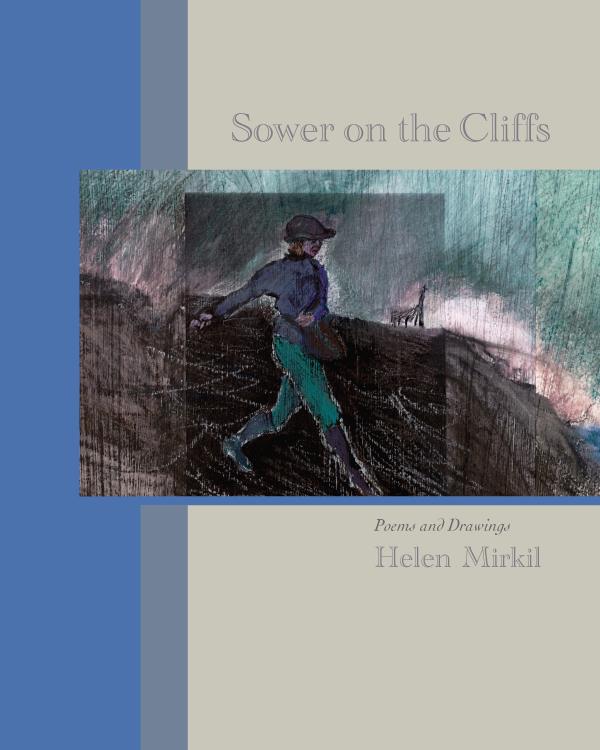
Sower on the Cliffs, Helen Mirkil’s book of poems and original sketches, works on the reader like one of those evening conversations over coffee where catching up with a friend has gone on for hours, yet when it’s time to call it a night, you feel like you’ve just gotten started. That’s because Mirkil’s use of language, mostly direct, gives you a sense of a door opening up before you.
The book is divided into 10 sections, each with only two to four poems bound to a theme. Many of them are family focused, some touch on losses, issues of faith and some tender moments with loved ones. Mirkil leads each section with one of her own sketches.
Like the sketches, black ink outlines, shapes and suggestions of shapes, Mirkil’s poems also follow the less-is-more approach, and that approach yields rewards as well as surprises at times. In poems like “The Station” and “Pressing In,” she offers a few details that act like an invitation for the reader to start making discoveries.
Home again. A knocking
At the screen door,
Parkinson’s. Let it in?
Read the rest of the review here at Philadelphia Stories.
 Frequently while reading Miriam Sagan’s latest poetry collection, Seven Places in America, I was struck with waves of jealousy. The book is constructed around her journeys and residencies at what, at least through her writing, must be some of the most wonderful places in the country for a poet to meditate on things great and small. This is especially true for a poet like Sagan, who has an affinity for the more rustic or natural places.
Some of these places were official writers’ retreats, while others were just places that accommodated her, and she accommodated them. Either way, she made the most of these visits, as good writers can, by using the foregrounds and backdrops as gateways for her poems to pass through or stretch out within. Her poems ride “the boat of the mind/that floats on air” tacking through waterways looking for purchase. When they land on hard ground, you know it, as in “10,000 Islands,” part of a series titled Ever/Glade (which, incidentally, made me think of Karen Russell’s novel Swamplandia.
I longed for departure
As if it were love
As if it would take me out
Of myself, of my accustomed way—
Sandbar of white pelicans
Lifts off, wheels into the sun
Silver flash of fish before the prow
Maze of low islands, one after the other,
Gives way
to open water.
Do you see what she did there? The very quiet leap from the silent meditation of longing for departure to the dramatic scene of birds rising and a boat rushing among islands. For me, these poems are at their strongest when she uses her environment as the A in an ongoing Q & A with themselves.
While I found poems to relish throughout the book, I think my favorites are in part V, which were written at Stone Quarry Hill Art Park in Cazenovia, New York. Maybe being a Pennsylvanian drew me to these poems as they describe scenery very like my own home.
In the first poem in that section, Sagan uses, with dramatic effect, the refrain “body of” in a chant-like list of things you might find in any eastern woodland.
meadowlark
body of liberties
forest
body of knowledge
dream
body of research
fireflies
body of principals
That’s fun, as are a lot of the poems in this book. You can feel the author’s delight coming off the page. At the same time, there are also haunting moments, such as in “Tree House,” where the speaker reflects in attendant language (“The creaks and meows of night,/Shadows of the copper beeches.”) on the material landscape of a childhood while simultaneously acknowledging the psychological landscape.
There were moments I thought the poet may have fallen into her own traps—pushed a metaphor a little too far, took the readers’ trust for granted, but then come moments of wonderful self-awareness, as if she knows where she’s taking us and is grinning a little inside, like here, in the poem “Stone Quarry Hill”:
If this poem were Chinese
I’d say my hair is gray (which it is)
And that I haven’t heard
News of you in a long time.
If I’m being played, I’m OK with it. Even when she asks “Why must inspiration be a vista?” you know she knows the answer is more complicated than that. “An inner self/that also shifts shape” is the visita we’re really meant to contemplate: “how what we ignored or couldn’t explain/remained in plain view.”
The poems in Doris Ferleger’s first collection, Big Silences in a Year of Rain bear a level of seriousness, responsibility and impact—and a heavy dose of insight. They dwell on memories and moments, usually painful ones, with both an astuteness and humanity that will prove rewarding to the reader. Professionally, Ferleger is a psychologist, so it’s probably no coincidence that many of the poems in this collection deal with suffering, loss, anticipation of loss and the methods of coping with all of the above. 

Many of the poems, particularly those in the first section, deal directly or indirectly with the poet’s heritage as the child of Holocaust survivors.
In “Victory” she writes:
My father considered
himself a success
when he found his children
still breathing. Each night
another victory over Hitler.
I learned early
to pretend I was sleeping,
to not be a burden.
In this collection we find a mix of narratives and lyrics, family histories, odes and elegies. She’s a deeply engaging writer, both of the world and people around her and of the perceived reader. While many contemporary poets seem to hold the reader almost in contempt, as if the act of communicating is a sort-of afterthought to the poem, Ferleger’s poems are meant to be affective. That’s something I like in Jack Gilbert, in Mark Strand and Betsy Sholl; and it’s something I especially like here.
Ferleger is not afraid of opening up, of revealing more about her life in a short poem than many people will reveal to friends they’ve known for years. That doesn’t make these confessional poems, truth for shock appeal. No, in these pages the poet’s spiraling toward truths comes across as a way of life, or, more likely, a way of dealing with life.
From “To Try Again”
Almost unbearable, this body,
unbearable the weight of this
snow cover
thick as a lover’s absence
on a spring day
when you have lost
the one you have slept
and eaten with longer
than three childhoods,
There are many times the reader feels invited into a family conversation, but these are heavier conversations than most families probably have at the dinner table. These are the moments that seem at once oppressive and also extraordinarily generous.
From “Scared”
Last night our son spoke to me
in a bristly tone but it didn’t
scrape me down this time. I just
said whoa, like that, a big whoa
came out of me in one short punching
breath. He stopped, even nodded.
My mouth felt like it could
blow away rock coral.
This poet is knows how to charge her language with emotion, but not sentimentality. Her imagery can be spiritual and concrete and compassionate, and clearly lived. This is not the book of a passive observer, and she chooses her words carefully to communicate that intensity. In “Oh Sages” Ferleger describes a scene in which a woman falls, dying, into the poet’s arms:
as she fell into my arms,
and she let go the last
particles of her supper,
leaving me there
to hold her bones, fat, flesh
the soul always leaves
to the care of failures?


