Form in poetry is more than just meter, stanza, and line break. It’s also a way of thinking. It’s the direction, pace and energy of the poem, and one of the main ways a writer can direct the reader’s experience. And, at least in my way of understanding, it’s also not something that’s simply visible on the page or scannable across a line. Shape and structure is metaphysical as much as it’s physical.
And this all is a way into my idea that all poems are triangles. Poems are kinds of vessels of energy. You cram a bunch of things in one end (images, concepts, sounds, ideas) and something else emerges from the other. Like a triangle, poems have a wide end and a narrow end. From a content point of view, a poem can start with a small point (a particular image, moment, or idea) and then expand, the way an ant hill expands as it gets to the base. Or the poem can start out large, with a wide idea that that covers everything, then narrows to make a particularly sharp point at the end. Think of that as a large funnel you dump the poem into, and it comes out a small opening at the bottom.
The most typical, at least in my experience (and in my own writing) is the poem/triangle that starts small and gets wider as it develops. Remember, I’m talking about the idea structure, not the line length or any other kind of structure. Often you’ll see a poem use some small moment or image as a trigger, which leads to another, and another, and as the images build, so does the idea and consequence of the poem. Take this William Stafford poem as an example:
At the Bomb Testing Site
By William E. Stafford
At noon in the desert a panting lizard
waited for history, its elbows tense,
watching the curve of a particular road
as if something might happen.
It was looking at something farther off
than people could see, an important scene
acted in stone for little selves
at the flute end of consequences.
There was just a continent without much on it
under a sky that never cared less.
Ready for a change, the elbows waited.
The hands gripped hard on the desert.
It starts with the lizard just sitting on a road panting, but almost immediately the poem starts to expand (“waited for history”) until at the end the poem seems to encompass the whole future in it.
This Jane Hirshfield poem does a very similar thing. It begin with on a small point, the young tree, and ends wide with “immensity taps at your life.”
Tree
By Jane Hirshfield
It is foolish
to let a young redwood
grow next to a house.
Even in this
one lifetime,
you will have to choose.
That great calm being,
this clutter of soup pots and books—
Already the first branch-tips brush at the window.
Softly, calmly, immensity taps at your life.
This poem by Natasha Trethewey, does the opposite. It starts with a large idea, almost the way an essay may start with a thesis statement, and then the poem progresses with details to support or explain the first idea, finally landing on a point, like a gymnast beginning with a large opening move then landing solidly on small, steady feet.
Theories of Time and Space
by Natasha Trethewey
You can get there from here, though
there’s no going home.
Everywhere you go will be somewhere
you’ve never been. Try this:
head south on Mississippi 49, one-
by-one mile markers ticking off
another minute of your life. Follow this
to its natural conclusion—dead end
at the coast, the pier at Gulfport where
riggings of shrimp boats are loose stitches
in a sky threatening rain. Cross over
the man-made beach, 26 miles of sand
dumped on the mangrove swamp—buried
terrain of the past. Bring only
what you must carry—tome of memory,
its random blank pages. On the dock
where you board the boat for Ship Island,
someone will take your picture:
the photograph—who you were—
will be waiting when you return.
Note that the wide parts of a poem tend to be statements or metaphors, while the narrow parts tend to be images. Metaphors, especially similes, are expansion devices. Look at what a simile does—it takes one thing, compares it to something else, and creates a third space.
First, of course this silly idea about triangles doesn’t always work. Some poems are straight columns. Some are so gerrymandered that you can’t even name their shape. So how do I use this concept anyway?
Thinking of the shape of a poem’s idea helps me visualize how its energy and pace work, how it tightens and speeds up, or comes to a pause. In composition this can help me overcome roadblocks. If a poem seems to be stalled at some point, not moving the way I want, I’ll overlay the triangle to it and test which direction the poem is pointing, what kind of base or point is has, and where the break in its energy is. This can sometimes help me solve problems I otherwise couldn’t see. Sometimes when I’m stuck on a poem but can’t seem to see the shape, I’ll try to carve a triangle out of it—the way a sculptor sees a shape inside a block of stone.
It also helps me when reading poems, especially when I want to analyze how a poem works. I’ll look at the opening and closing to figure out which is the wide end and which is the narrow end. Is the narrow end a landing or the tip of a funnel. Does the wide base allow the idea to keep growing beyond the poem?
—

 Let’s say the typical contest prize is $1,000 (some pay out more, few pay out less). I looked at my last three books and saw that I averaged 12 submissions for each one, at about $28 for each submission. That’s $336 spent getting each book published (update–I’ve way exceeded that for my 6th, still-unpublished manuscript). Some of those fees give you the winning book or a subscription to a journal, so they’re not all just lost money. But still, I figure I have to budget at least that much for my next book (see update note above). Let’s say I win one that pays me $1,000 (my last one paid more—Yay! but play along anyway) plus 20 author copies. Of course I’m going to want more than 20, so I pay the author accommodation price, which tends to be fifty or sixty percent of the cover. Let’s say the book costs $16, so my price will be $8 a copy. Pretend I buy 100 copies because I plan to do a lot of readings. That’s $800, plus the $336 I would have spent in contest fees, and I’m already $136 in the hole by the time I’ve signed the contract.
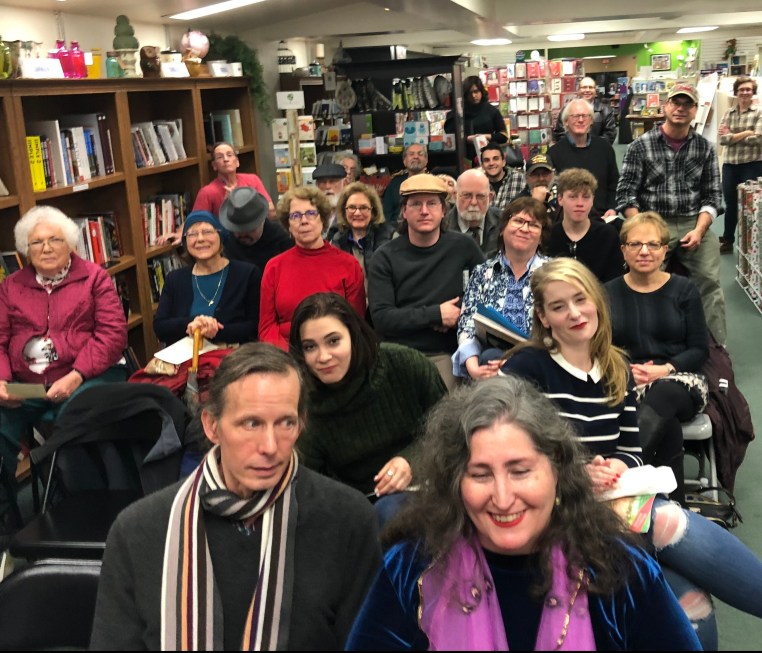 What about bookstores? Bookstores are great places to read, especially if the place has a long-established reading series, but they present another financial challenge to the writer. Bookstores are in the business of selling books, and they offer you a venue and an audience, so they expect a cut. If you bring your own books, the store will usually expect about a 40% cut. So maybe you sell a few copies, and the store takes 40%, which leaves you with $9.60. But you paid $8 for those books, so now you’ve only made $1.60 per book. How many do you need to sell to make that bookstore reading worth the trip? Of course one good paying gig at a college could make up for several disappointing coffee shops. (Note: I don’t begrudge bookstores their need to make money–they have staff to pay and lights to keep on, but it’s still hard on the small press poet.)