I used to be hooked on four to six line stanzas. I loved the pressure that small packages forced on me, the fact that I needed to squeeze a moment or impression into a six line box, then move onto the next one was both an organizing factor, and a way to allow my mind to make multiple leaps within a poem.
Here’s how I typically composed: A first line or image would kick off the writing session. I’d randomly (usually based on how the first line went) select a basic stress count (somewhere between 5 and 7 beats per line was typical), though I rarely went for any strict meter. By the time I’d get to the third line I’d start to look for ways to tie up that stanza and allow me to move to the next.
This process of working on one stanza at a time, rather than trying to approach the whole poem at once, made the writing process less intimidating. It’s like cleaning a room by dividing it into sections—first I’ll tackle the desk, then the bookshelf, the closet, then the floor… By focusing on one step, or stanza at a time, I could keep the progress going without actually worrying about where it would end up.
Usually the same decision system I applied to the stanza length would surface in the overall poem length. Mostly due to my short attention span, and dislike of longer poems I’d start thinking of an exit by the time I finished my third stanza. This is probably why most of my poems from that period are made of four or five stanzas.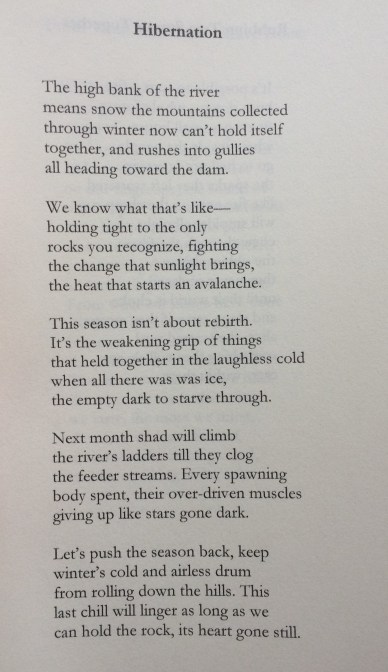
Here’s an example of one of those poems, as is the one pictured to the right.
The benefit, at least in my mind, of all those stanza breaks, is that they allow frequent jumps, such as scene changes, logic changes, even language shifts, without throwing the whole poem off the sofa. I could be talking about a bridge or a beach and then in the next stanza shift to room or a person, which all seemed to be allowed in that form. Those movements let me do things with poems that other approaches to building wouldn’t, and for several years it became second nature, as if my mind naturally worked that way.
One thing that format didn’t do for me was allow for a certain forward momentum, and along with that, a drama brought on by that momentum. When a poem is full of stops or pauses, it doesn’t pick up a lot of speed. That’s an effect I began for, and one I could only seem to find in longer unbroken poems. That seems to be where I’m at a lot these days (as people in my monthly writing group have noticed). I’ve been forgoing the stanza breaks and scene shifts for shorter lines, longer poems (though not too long) and more of a dramatic arc.
Poems that lack stanza breaks need justification to keep going without giving the reader a breather. At the same time, unbroken poems can exhibit a kind of steady momentum that often meets a key turn moment, and then rolls into the end. I picture it like holding a hose and spraying into the air—the water arcs upward, gaining power, hits its peak, then cascades down to the ground, gravity taking over.
Here’s an example that I think pulls off what I wanted.
I’ve liked working in this form, but it can cause other challenges. How do you keep or increase momentum? How do you shift ideas but still maintain the narrow lens focus? Or, alternatively, do you use the form to allow a wide-ranging wandering? Attention to how I use caesuras, transitional phrases, repetitions and other rhetorical tools play a role. I talk about some useful tools here and here, but there are endless others. Like any writer, I’m trying to figure it out on a case by case basis.
One of the reasons I like to try on different forms is to prevent getting stuck in a rut. I’ve seen poets who haven’t evolved their style over decades. Richard Hugo is the most obvious example, and except for 31 Letters and 13 Dreams, he wrote the same style of poetry his whole lifetime. I don’t want to get bored with my own poems, and I also want to explore new ways of doing things.
—
 I have a poetry group that meets once a month at a pizza shop. We’ve been going there for years, so the servers know us well enough to get our drinks without asking what we want.
 When I dug into Brian Beatty’s new poetry book, Brazil, Indiana, I was in the middle of season 2 of Twin Peaks (I liked season 1 better), so it’s probably no surprise that I spotted some of the same small town surrealism in Beatty’s book-length poem as is found in Peaks. There’s a man who trains moths, a man who half buried an old truck to spend days sitting in it, a town giant and of course a crazy cat lady.
 About two weeks after the 2016 presidential election, poet Richard Blanco came to Bucks County Community College for a reading to kick off the college’s Many Voices, Many Stories writing conference. Before the reading, Blanco and I sat down in a little stone cottage on campus to discuss the role of poetry in society, his own writing process, and some of the challenges facing people who enjoy the craft. Read the complete interview at

