The Weight of Poetry

Hatfield is foggy this morning, and most of the snow has melted off. My adult kids have returned to their towns, and the holiday leftovers eaten or tossed. I’ve got some books to mail, some poems to send to the black hole of Submittable, and a few new drafts to sit with. 

I woke this morning with the remnant of a dream in which I was talking with a famous poet (I won’t say who) about how heavy poems were. Lately I’ve been working on a poem about trains.  I have my father’s old Lionel train set, which he gave me a couple years ago (I can’t say inherited, because he’s still living, but inherited feels more accurate). While I didn’t really care for toy trains when I was a kid (I had a Tyco racecar track instead), they seem important to me now because it was important to him that I or my brother take the set rather than let it go to a stranger. It’s a post-war classic train set about 75-years old, and amazingly still mostly works. I even added two new cars myself, and the old engine manages to pull them. This year it chugged a circle under my Christmas tree. 

Anyway, I’ve heard people talk about how finishing a poem feels like relieving themselves of a weight, wringing something out of their body. For me, it’s the opposite. When you create something new, you have a responsibility for it, and you carry it with you. It’s like Jacob Marley and his burden of chains. I made those poems, and now I drag them around with me wherever I go. Some I’m quite proud of and wear like a nice sweater, yet there are plenty I’ve spent months working on but would never drag out in public. I think even the ones I’ve deleted and abandoned are still clawing onto me in some way–maybe like adding cars to that old train. 

With each new poem, a poet becomes something more. I’m not sure what it is, or if it’s better or worse, but writing a poem isn’t shedding a skin, it’s adding layers to an existing one. An old poet is a giant snowball after rolling down a hill, twigs and pinecones sticking out at odd angles. 

And I’m starting to like that train poem. 

Temporary Shelters is now available at Bookshop and Amazon.

Almost Christmas Poetry

Almost Christmas Poetry

W’ere a week away from Christmas. The weekend snow is melting, though still hanging around. My kids will be coming home soon and I hope to share some winter hikes with them.

Anyway, the lovely poetry website One Art published two Xmas-themed poems of mine. One takes place in a dismal shopping mall where a pall of the season’s (year’s) malaise looms over everything except the lone mall caroler.

The other is mostly a metaphor for the hard passage of time, the burdens we carry, especially this time of year–typical holiday stuff.

You can read them both here at One Art.

And if you want to hear me read some poems live, please log onto my reading Saturday at 7pm hosted by Wordhive.

Temporary Shelters is now available at Bookshop and Amazon.

Video for Gunpowder Homestead

I’m happy to share the third poetry video from my book Temporary Shelters. The poem, Gunpowder Homestead, explores my fascination with the old house ruins and foundations I sometimes run into on woods hikes in my home state of Pennsylvania.

Whenever I encounter a place like this, I think about the people who lived here once 150 or more years ago–how their lives were different from mine, how the land and the world may have been different, and what happened that the place fell into ruin.

The poem was first published by Whale Road Review and now appears in my book Temporary Shelters.

Hang around until the end to hear the short interview.

This video was shot and produced by Bare Bones Filmmakers.

Reading The Water: Form and Content in Fishing and Poetry

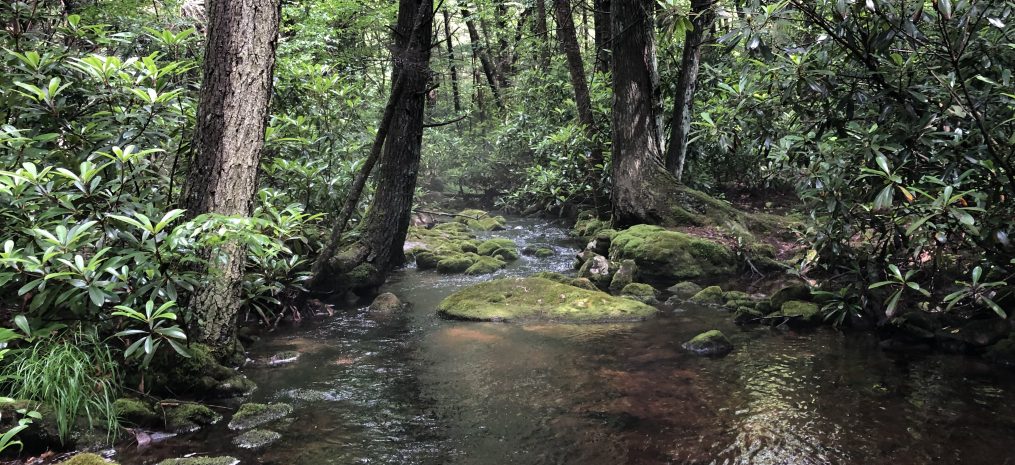
Not long ago I hiked down a gameland trail into a gorge thick with hemlock and rhododendron to look for a small creek named Devil’s Hole. The name comes from the way the creek emerges through rocks via an underground aquifer and disappears under the earth a few more times throughout its course to join another creek curiously named Paradise.

After a good rain, Devil’s Hole is still only 10 feet at its widest. It tumbles over and around boulders of Devonian sandstone left there when the Pocono formation was rearranging itself like a dog getting comfortable on a sofa. The topography creates plunge pools, short shallow runs, cascade falls a few feet high, and cutbanks shadowed by the bent elbows of mountain laurel. It is a remote, mysterious, and beautiful place.

I went there looking for brook trout–small, wild jewels far away from the stocked waters where most anglers go. As a catch-and-release fly fisher who likes to avoid people, this kind of angling is more about the experience than about catching fish. I go to observe the motions –water on stone, current on insect, stillness and rise– form and content defining each other.

Water in motion, like poems, is made of multiple currents, obstacles, fast sections and slower spots. The center channel may be deep or shallow. A gravel bottom holds different insects than a silt bottom. Boulders hide small pockets of stillwater. The steep bank is hard to enter, and then again hard to climb out of. Understanding those variations and learning to use them is what anglers call “reading the water.”

Because I know the region pretty well I already knew what kinds of fish and aquatic insects it would hold for the time of year. That’s the kind of knowledge that comes from having read a library’s worth of rivers.

But, as with a good poem, you can’t know everything ahead of time. At some point you’ve read enough Mary Oliver poems to know what you’re getting into when you enter one, but nothing prepares you for “The face of the moose is as sad / as the face of Jesus.” in her poem Some Questions you Might Ask.

So you read each water anew.

“One question leads to another.” says Oliver. Like a good poem, moving water asks you questions over and over again. What will the current do if I mend my line upstream? Will that boulder hide a trout or a hellbender? Can this log support my weight, or am I going to get wet?

I want poems to prompt questions the way a river or creek does. A stanza break, a caesura–these are moments in motion. Moments when you read the currents around them, observe the words doing things to each other, doing things to you, forcing a response. An enjambment is a bend around a boulder; a stanza break may be the stone you cross to continue on the other side. Form is what gets you there, what shapes your approach to the water.

But as any angler knows, some creeks don’t give up their answers easily, though hopefully their questions invite you back to give it another try. Sometimes you land the fish. Sometimes you don’t. Draft, fail, revise.

I encourage my poetry students to be observers and questioners. Why is this element here? What does it do? How does it affect what comes next? It takes time and practice to understand the machinations of water in motion. It’s the mixture of patience and humility that smooths a rough impatient stone.

Lately, I’ve been moving away from leading workshops with the goal of re-engineering a poem, and more toward learning to read it. And also asking the writer to think about why they wrote it the way they did. As an angler, the better you get at reading rivers, the more you’ll appreciate each new water you step foot in, and the better you’ll be at teasing a fish out of it. As a writer, as you learn how water works, you get better at making it work for you.

That trip down to Devil’s Hole included half a dozen creek crossings. I found bear scat along the bank, a few trout in places I expected them to be, and some where I didn’t. It’s that combination of recognition and surprise that makes a good experience on the water. I lost one fish, probably the biggest one of the day, and the strike still sends jolts into me when I think about it.

And I think about it a lot.


My latest book, Temporary Shelters, is now available at Bookshop and Amazon.

2024 Update and stuff

Well, it’s been a while. I hope your year has been free of major trouble. Here’s a sneak peek of the likely cover of my next book, coming out in 2025 from Cornerstone Press.

In the meantime, if you’re looking for something good to read, I highly recommend a new anthology, The Literary Field Guide to Northern Appalachia (edited by Todd and Noah Davis and and Carolyn Mahan). it pairs descriptions, habitat and lifestyle notes on key species in the region with poems about those species. Yes, I’m included (my entry is the the mayapple). Among the other poets included are David Baker, Kasey Jueds, Chase Twichell, Lee Upton, Marjorie Maddox, K.A. Hays, Michael Garrigan, Jerry Wemple, Chard deNiord, and many more.

In addition to my Rosemont poetry classes, I was happy to teach a couple of guest workshops for the online poetry journal OneArt (edited by Mark Danowsky). Those were fun, so I’ll probably do another next year.

I have a few more poems included in the Poems section of this site. I’ll continue to include more as they become available online.

Finally, like many others, I’ve left twitter for Bluesky. Find me there @grantclauser.bsky.social

that’s it.

gc

New Book Forthcoming

My sixth poetry collection, Temporary Shelters, will be published by Cornerstone Press of the University of Wisconsin | Steven’s Point. It’ll be a year or so until it comes out. I’ll leave updates here as it gets closer.

I also have work forthcoming in the anthology, The Literary Field Guide to Northern Appalachia, published by the University of Georgia Press, also some literary journals including Whale Road Review, Bear Review, and Cimarron Review.

New Year’s Day Poem

I wrote this on New Year’s Day 2013, I think. The day before I’d spent a few hours hiking around Peace Valley Lake in Bucks County, so that’s where some of the imagery began.

New Year’s Day

The woods smell like good dogs

in the rain, walnuts and acorns cracked

and crunching under boots, the kind

of light that comes like notes

in music, rests where it needs,

holding onto bare bushes or

the cracks in fallen trees.

It’s not the rot and rhythm

of woods that’s right,

the lie of snow against water,

a shifted step from stone to stone

and the life he thinks he lives.

The trail is wide and flat

with rocks he names for dogs

he knew, dark hackles raised to the light.

Interview with Poet Harry Humes

harry-humes BWPennsylvania is teeming with exceptional poets. One of my favorites, and one of the first poets I connected with, is Harry Humes. I was first introduced to Harry by Dick Savage, a professor in the English Department of Bloomsburg University when I was there in the 80s, who also served as an informal mentor to both of us  (though many years apart). While at BU I met Harry at a writing festival at nearby Bucknell University, and we’ve met up and corresponded from time to time since then. We both share a love of the wilder places in Pennsylvania, particularly the state’s mountains, rivers and streams–which we both stalk with fly rods for trout.

Harry earned an MFA in poetry at the University of North Carolina Greensboro in 1967. He taught in the English dept. at Kutztown University, and currently teaches a fiction writing class at Cedar Crest College.

Harry’s work has been featured in numerous journals and the Best American Poetry 1997. He’s been awarded a Theodore Roethke Poetry Prize, National Endowment for the Arts fellowship, Devins Award and others. For many years he also ran the poetry journal Yarrow.

What is it about revisiting past events that they become triggers for your poems?

I think mine live inside of me. That’s to say that Girardville is always there. It doesn’t drag me down; it’s just rich. Growing up in a place for 20 years, everything you know, everything you found out about, you learned one way or another in the first 20 years of your life. All the important stuff is there. I didn’t think I was paying a whole lot of attention to things when I was growing up, but obviously I was paying attention.

As poets, we’re consciously paying attention to things, looking for material, but as kids you don’t think that in 20 or 30 years these events will become poems. Is recreating past events and details a challenge? Is there embellishment?

Oh yes, I make things up a lot. I start with something that happened, but then sometimes I lose interest in it, so I start inventing things about it and other people. I’ve imagined a lot of things that didn’t happen but could have happened.

Girardville was a wonderful place to grow up for a kid, but it was also very dramatic and dangerous. The mines were there, the mountains… we just roamed around like crazy. My mother had to worry about her husband going out to the mines every day. So anyway it was profoundly there. I didn’t think about it for years… I had some dead-end jobs and then got drafted, and when I got out of the army and went to school and began thinking (and that’s when I met Dick Savage) that maybe I could do something with that experience. But I didn’t starting thinking about the coal mining poems, the father poems, until many years afterword and started mining that material for poems. I had been writing about fishing and nature, girlfriends and so forth. But later the town became central.

I lived in the coal valley, and it was torn up. There were trucks and trains and so forth, but right over the mountain I could hike out of my valley over the top and down into this agricultural valley. There was a clean trout stream running through the middle of it, and it had fields. And there was no coal mine. Sometimes I’d fish or sometimes I’d just mess around, and then I’d hike back over the mountain back to my valley. So this gave me two landscapes. I had the coal mining landscape and the other landscape. Those two are my dominate landscape, and the people in them. So I’m constantly in nature. Dick and I talked about this a lot, that what we find in nature is more than pretty flowers; it’s something else. He introduced me to Wordsworth and Blake and the others early on.

You mention the dangerous and dark environment of the mining valley and the green and light farming valley. I noticed a lot of duality in some of your poems? Was that an approach you established early in your writing?

It took me a long time. After Bloomsburg I went to the University of North Carolina and the MFA program. I thought then I’d bitten off more than I could chew because these guys [the other students] had been writing for a long time. But I developed a whole lot in those two years. It took me forever to learn how to do it. I tell my students don’t even think about doing anything serious for the first 10 years. Gerry Stern used to say “read a hundred books, then write a poem.”

Process? It just sort of happened. It just poured for about 15 years. Something became unplugged. I think something in me knew not to get to the good stuff until I was able to write about the good stuff. Then they all came out. Over a period of 15 or 20 years they all came out. Now I fiddle around. I didn’t think too much about process. For a while I thought about writing in form. I wrote in form and meter and rhyme and published some, but then went back to the free verse stuff and never looked back.

Talking about beginnings, middle and ends–endings have always been hard for me, they still are and come harder now than they used to. Metaphor was always there. When the plug got pulled there was a torrent of metaphors and imagery.

I’ve never been quite sure when I’m writing a poem what I’m doing. It’s like fishing. You know what you’re doing because you’ve been fishing in the water and you see things in the water… but I write, and then things have an instinctive way of happening. I’ve started poems about one subject and they morph into something else, because something in the poem said change the subject. And it’s like that with endings. I’ll get near the end, but it might take me another week or two to come up with the right lines to end it. It’s like looking at a piece of water and just knowing there’s a fish in there. All you’ve gotta do is just fuck around long enough to get him out one way or another.

butterfly-effect

Butterfly Effect, a 1998 National Poetry Series selection.

Yes, that’s exactly right. Every now and then I’ve tried to write a sequence of poems, and I’ve never been able to do it. I get two or three poems out in the sequence, but then it starts to fade. I lose interest. Poems come to me from nowhere. There seems to be no rhyme or reason for why they turn up. I’ll be looking at a corn field and something will come to me. It’s often about wherever I happen to be.

I was fishing on the Little Lehigh last night and had a good hour and a little sulfur hatch, and I put on a comparadun fly, and so there I was fishing and thought, “This is pretty nice. Maybe I’ll write a poem about this.” and then I thought “don’t write another fishing poem.” So poems just happen. I don’t go looking for them. Sometimes I think I’ve got two sets of eyes. One is for living and one is for looking for poems.

A lot of your poems deal with some work or craft, someone building something or working with tools. Is because those are part of the memories or preserving something of a lifestyle we don’t really have anymore?

I have things in my room here that belonged to my father. I use his hammers and saws that he never let me use as a kid. I have a poem now that I’ve been playing around with about a cellar door. It was the house in Girardville and inside the door were the knee-high mining boots that he used to wear. So yes, tales like that I love to bring into poems. I try to get my students to think of things. We live in a world of things, and that’s what makes a poem alive for me.

Many of your poems have a journey—hiking to a swamp or crossing a mountain—that can seem almost mythic. Are you using these places as vehicles to explore an inner world as well?

Sure. I think anyone who writes does that. I did a poem last year called Climbing the Wall. We used to a lot of climbing on the slate walls after the coal had been taken out. It was very dangerous. I had to climb over those walls in order to fish in the valley on the other side. So I played around with that.

Anyway, sure, swimming, hiking, the journey metaphor is there. The other day we were up on Hawk Mountain, and the journey of the hawks is always quite stirring for me, so I wrote a poem about it of course. You go from here to there, and that’s our life.

When it comes time to assemble a collection into a book, what do you consider when deciding what to include and how to order it?

I’m in that process now. I have about 50 poems that I didn’t think were going to go anywhere and over the last couple of week’s I’ve been looking at them and thinking maybe they could be a book. So I’m looking at them again, and eventually I’ll get around to putting them all over the living room floor. Again, it’s instinctive. It’s like writing the poem in the first place. I know the way the poems should come together, I know what I’m looking for, but I don’t know that I know. The hardest one was my first one, Winter Weeds. It’s a long process, and I’ll probably spend another six months deciding what poems I want to keep and what I want to throw away. You have to make hard choices sometimes. If there’s the least little thing I’m not satisfied with in a poem, I put it in the maybe pile. It’s like knowing there’s a little misfire in a motorcycle engine—something isn’t working. I don’t think in terms of a collection when I’m writing. I think of the poem.