Philadelphia Poet Louis McKee Has Died

Louis Mckee, a fixture in the Philadelphia poetry scene, passed away Monday November 20th. Coincidentally that same day I had sent him an email about a poem of his published in Rattle in 2001.

I only personally knew him through correspondence, letters and emails, and an article he generously wrote for me, but I knew him much better I think through his poetry. The December 3rd launch reading for the next issue of the Schuylkill Valley Journal will be dedicated to him. It will take place at the Manayunk Art Center. That issue also includes three of his poems.

That poem from Rattle seems appropriate to me now, so I’ll post it here:

A Beautiful Day in September

Today I stood in my back yard

leaning on the cold wrought iron grate

and realized, watching the blue

skies, the slow white clouds

moving behind the old church spire,

that this was a beautiful day,

one that I should remember,

and it made me smile to know

that I could know such things,

and sad, too, to know that

I would know so few more.

I wish I had paid more attention

when I was young; that I had

looked up more, instead of straight on.

Two children bounce a ball

back and forth, dance

to a familiar song on their radio.

The woman next door kneels

in her small victory garden

gathering last tomatoes,

and peppers, too, it looks like.

A pretty young woman waits

on the corner for a bus

and a mischievous breeze

sweeps her long chestnut hair

away from her settling hand,

away from her cigarette;

she moves in her own sweet

dance, reaching wonderfully

to hold it all together.

That’s all I’m trying to do.

I love the combination of gratitude with regret and awe in this poem, characteristics which surface frequently in his work.

Also, here’s a link to an interview with Lou on the Mad Poet’s Blog.
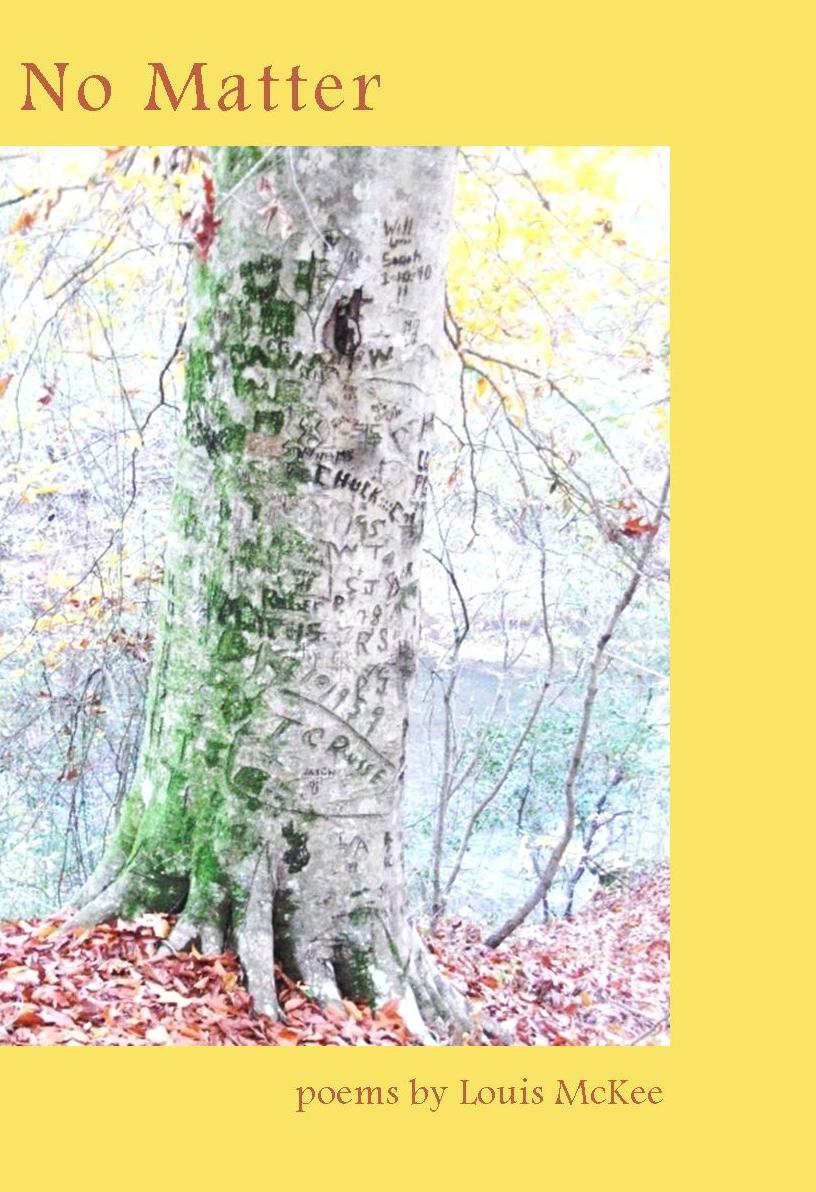
His 1987 collection No Matter, was just released by Seven Kitchens Press yesterday. You can find it here. We all wish he was around to enjoy the new publication.

Below is an announcement sent from Eileen D’Angelo of the Mad Poets Society:

Dear Friends,

With a sad and heavy heart, I am writing to let you know that our friend and Philadelphia poet, Louis McKee, died yesterday, November 21st.

A dear friend of so many of us on the Philadelphia poetry scene, Lou was most definitely one of its greatest voices. His passing is a great personal loss, as I know it is a great loss to us all. It is an understatement to say that he will be missed by many.

Plans for a memorial service are underway.

Sincerely, Eileen

Here’s a fine remembrance article on McKee written by poet  Fox Chase poet G.E. Reutter.

Louis McKee (born July 31, 1951, Philadelphia, Pennsylvania) has been a fixture of the Philadelphia poetry scene since the early 70s. He is the author of Schuylkill County (Wampeter, 1982), The True Speed of Things (Slash & Burn, 1984), and fourteen other collections. More recently, he has published River Architecture: Poems from Here & There 1973-1993 (Cynic, 1999), Loose Change (Marsh River Editions, 2001), and a volume in the Pudding House Greatest Hits series. Gerald Stern has called his work “heart-breaking” and “necessary,” while William Stafford has written, “Louis McKee makes me think of how much fun it was to put your hand out a car window and make the air carry you into quick adventures and curlicues. He is so adept at turning all kinds of sudden glimpses into good patterns.” Naomi Shihab Nye says, “Louis McKee is one of the truest hearts and voices in poetry we will ever be lucky to know.”

Near Occasions of Sin, a collection issued in 2006 by Cynic Press, has been praised by Brendan Kennelly: “I really admire, and like, deeply, Louis McKee’s poems. They have two qualities I love – clarity and candour. And they often tell stories even as they evoke mysteries of being. And they engage a great deal with people. “The Soldier,” for example, is stunning for its pure drama. Then, he is a moving, complex love-poet, at once passionate and reserved. McKee’s poems are like flashes of spirit rooted in the body. He never hides behind, or in, obscurity. Near Occasions of Sin is utterly unpretentious because his genius (I think he has that) is so real; “I am content with this,” he says at the end of “Failed Haiku,” and this readiness to be himself, in all his complexity and simplicity, is, I think, the basis of the appeal of this most unusual and attractive book. Sometimes, McKee talks to his reader and it is like talking to a next-door neighbor (that’s what I mean by candour in these poems). Also, they sound like songs at times-winged, humane, vulnerable.”

Philip Dacey, writing about McKee’s poetry in Schuylkill Valley Journal (#24, spring, 2007) says, “It is the essence of McKee’s work to be rich in artifice and craftsmanship and informed poetic strategies while at the same time consistently brave in its presentation of two confrontations: a person’s with himself and that person’s with the world outside himself. To read McKee is to witness drama and struggle; if the art is hard-won, the human victories are, too.”

Warren Woessner, in the American Book Review (Jan/Feb 2007, Vol 28, No. 2), writes that McKee’s poems have a “surprising honesty…. In this era of superconfessional hubris, we are told that no topic is off-limits, but, if this is so, why are so many of these poems startling? Picasso said, “art is not truth,” and I know that to be true, but it is important to the force of these poems that I can believe that the poet is giving us his stories straight up.”

McKee was a longtime editor of the Painted Bride Quarterly. During his tenure, he edited three special issues, celebrating the work of Etheridge Knight and John Logan, as well as a retrospective, 20th-anniversary volume of the PBQ. He currently operates Banshee Press and edited the magazine One Trick Pony until its demise in 2007.

Louis McKee[edit] Bibliography

Schuylkill County (Wampeter Press, Green Harbor, MA 1982)[1]

The True Speed of Things (Slash & Burn Press, Philadelphia, PA 1984) (Reprinted: Nightshade Press, Troy, ME 1986)[1]

Safe Water (Slash & Burn Press, Philadelphia, PA 1986)

No Matter (Pig In a Poke Press, Pittsburgh, PA 1987)

Oranges (M.A.F. Press, Portlandville, NY 1989)

Angelus -a broadside issue (Lilliput Review, Pittsburgh, PA 1990)

Three Poems -a chapbook (Verse Press, Narberth, PA 1993)

Last Seen -a pamphlet (Red Pagoda Press, Reading, PA 1999)

River Architecture: Poems From Here & There: A Selected Poems 1973-1993 (Cynic Press, Philadelphia, PA 1999)[1]

Right as Rain (Nova House Press, Rosemont, PA 2000)

Loose Change (Marsh River Editions, Marshfield, WI 2001)[1]

Greatest Hits 1971-2001 (Pudding House Press, Johnstown, OH 2002)

Near Occasions of Sin (Cynic Press, Philadelphia, PA 2006)[1]

Marginalia (Translations from the Old Irish) (Adastra Press, Easthampton, MA 2008)

Still Life (Foothills, Kanona, NY, 2008)

Jamming (The League of Laboring Poets, San Clemente, CA, 2008)

[edit] As editor

Etheridge Knight: A Celebration (A special issue of the Painted Bride Quarterly-PBQ, Philadelphia, PA 1988)

John Logan (A special issue of the Painted Bride Quarterly-PBQ, Philadelphia, PA 1990)

PBQ: A Poetry Retrospective 1973-1993 (A special issue of the Painted Bride Quarterly-PBQ, Philadelphia, PA 1993)

References

PA 1984) (Reprinted: Nightshade Press, Troy, ME 1986)[1]

Safe Water (Slash & Burn Press, Philadelphia, PA 1986)

No Matter (Pig In a Poke Press, Pittsburgh, PA 1987)

Oranges (M.A.F. Press, Portlandville, NY 1989)

Angelus -a broadside issue (Lilliput Review, Pittsburgh, PA 1990)

Three Poems -a chapbook (Verse Press, Narberth, PA 1993)

Last Seen -a pamphlet (Red Pagoda Press, Reading, PA 1999)

River Architecture: Poems From Here & There: A Selected Poems 1973-1993 (Cynic Press, Philadelphia, PA 1999)[1]

Right as Rain (Nova House Press, Rosemont, PA 2000)

Loose Change (Marsh River Editions, Marshfield, WI 2001)[1]

Greatest Hits 1971-2001 (Pudding House Press, Johnstown, OH 2002)

Near Occasions of Sin (Cynic Press, Philadelphia, PA 2006)[1]

Marginalia (Translations from the Old Irish) (Adastra Press, Easthampton, MA 2008)

Still Life (Foothills, Kanona, NY, 2008)

Jamming (The League of Laboring Poets, San Clemente, CA, 2008)

As editor

Etheridge Knight: A Celebration (A special issue of the Painted Bride Quarterly-PBQ, Philadelphia, PA 1988)

John Logan (A special issue of the Painted Bride Quarterly-PBQ, Philadelphia, PA 1990)

PBQ: A Poetry Retrospective 1973-1993 (A special issue of the Painted Bride Quarterly-PBQ, Philadelphia, PA 1993)

For Robert Lowell, on His Birthday

robert lowellRobert Lowell has for years been one of my favorite poets–one of those writers who’s books stay at my bedside. The pages are dogeared and scribbled on, words underlined. I love how he paces a poem, pulling the reader along like a show horse at a demonstration, jumping rails or pits along the way. I’ve also always been bothered by how some critics dismissed him as a confessional poet because he wrote about his own life, the tragedies and depressions. Sure, that’s subject matter, but that ignores what a fine craftsman he was, one of the finest at tying tightly wound knots in his lines and beautifully evocative images. He was also a master an tossing out a direct hit in the face straight line (“I myself am hell.” or “My mind’s not right.”)

Anyway, he would have been 94 today. Here are readings of a few of his most well-known poems. The last one is a reading performed by my friend and former teacher, Rafey Habib.

Interview With Sam Hamill on Translating Poetry

Once a month I meet with a group of other poets at a local restaurant to talk about poetry and to workshop some poems. At a recent meeting we were looking over translations of Japanese poems by Sam Hamill, and we began discussing the subject of translations and the challenges they create for the translator and the reader.

To help answer a few of the questions, I decided to go to the source himself.

Hamill has published at least 14 volumes of his own poetry and about two dozen collections of translations from Chinese, Japanese, ancient Greek and Latin and more. He co-founded Copper Canyon Press and created Poets Against War.

How important is it that the translating poet be fluent in the language? Many people doing translations today work with someone who is fluent to get a literal translation, then the poet-translator steps in to take over.

There is no exact equation for great translation. Pound knew no Chinese and his source, Ernest Fenollosa, knew none, and Fenollosa’s sources, two Japanese art professors knew Li Po’s poetry only in Japanese, hence Pound “translating”  Rihaku—Li Po’s name in Japanese. Against all odds, we got 14 amazing poems, including one that is actually two poems combined. Pound’s “errors” have been noted time & again by his critics as well as by Chinese literary scholars. And yet the poems are among the most influential of the last century.

Stephen Mitchell’s “translation” of Tao Te Ching, on the other hand, is fabrication. His version was apparently “transmitted” by his Korean Zen master. In one chapter, 55, I think, there’s not a single word from the Chinese. This tome has misinformed a hundred thousand readers. Both Red Pine (Bill Porter) and I have translated Tao Te Ching in very literal ways, and comparative readings reveal a lot.

Robert Hass’s famous “translation” of a haiku by Issa bears only faint resemblance to the original, which I translate literally:

New Year greeting-time:

I feel about average

welcoming my spring.

Medetasa mo

chugurai  nari

ora ga haru

“Medatasa is a seasonal greeting, not New Year Day as Hass has it. Then Hass simply invents a line two: “Everything is in blossom!” which is not what line 2 says; “I feel about ‘chugurai’ middle or average,” which Hass turns into a punch line” “I feel about average.” Gets a nice audience response, but Issa didn’t write about blossoms in Feb in Japan. The poem asks for meditation, not a punch line.

My Chinese and Japanese is not good. But I enjoy immersing myself one word at a time, one line at a time, getting deep inside the poem and “finding” the poetry. I get help from scholar-friends and I wear out dictionaries. Bill Porter is a far better scholar, but less of a poet. I have learned a ton from him, as from translators like Burt Watson, J.P. Seaton, Rexroth, Edmund Keeley’s Seferis and Elytis, etc.

It’s always best to have a scholarly annotated translation along with one that focuses on the poetry— a “poet’s translation” —when dealing with complicated poets like Dante or Pindar.

The Poetry of ZenPrecise word choice in poetry can make or break a poem. In the writing group I moderate, we may spend 20 minutes discussing the use of one word. When reading translated poetry, I worry that the translator may not have the same word sense as the original author or that the English word may have connotations or associations not present in the original word (or phrase). How big of a problem do you believe that is?

Some words don’t translate. Some images don’t translate. Chinese syntax doesn’t follow English grammar. When the classical Chinese poet speaks of “clouds and rain,” it may be a reference to sex as well as to the weather: Clouds are masculine, rain feminine.

Translation is a provisional conclusion, that’s why the same classics need to be retranslated periodically. Translators develop their voices, just as emerging poets do, or prose writers for that matter. Scholarship can’t make up for a weak ear or failure of imagination. “Poetic licenses” come with major restrictions if one is respectful of the original

Is the translator’s responsibility to be true to the original author or to produce a good poem? I’m guessing it’s a little bit of both, but where’s the scale for you?

You can’t be “true” to a poet while turning his/her work into bad poetry. All one need do is look at what happens when formalists try to translate Chinese (which, by the way, employs both interior and end-rhyme). Chinese is a rhyme-rich language. American English is not.  Add the fact of needing to add particles, prepositions, conjunctions, decide gender when it’s indeterminate, etc. changes the poem in various ways. Chinese is also very good at plurisignation—one word may convey two or three distinct meanings all at once, and the translator must choose one.

You’ve translated poems from several languages, several different cultures and traditions sometimes separated from yourself by hundreds or thousands of years. How do you deal with the possibility of lost intention in the poem in those situations?

No one knows exact “intentions” in ancient poetry. We surmise. I have passed over a lot of poems just because they don’t make good poems in American English. For instance, Li Po wrote many occasional poems, many poems with bizarre flights of fancy that just don’t translate. We don’t know how much of Tao Te Ching Lao Tzu actually wrote, but we know that much of it existed in various forms, so he was more editor-translator than author.  Intentions?

I translated Catullus simply because the scholars were too timid to recreate his invective. Catullus invented a word, defutate, which one scholar translated “sexual exhaustion.” But a truer translation would be more raw: “fucked-out.” He was an uproarious defiant poet, and we know he, like Dante, bore grudges and used poetry to mock and/or condemn his enemies. He also translated Sappho, including her “mixo-Lydian Mode” into Latin, where it became the foundation of the “heavenly music” of the Catholic church.

How similar do you think is the experience of a contemporary reader reading, for example, Sappho or Saigyo, to the experience of a contemporary of those poets? Do you hope to recreate that experience or a new one?

Can’t possibly be done. We’d have to recreate a 7th century Taoist-Confucian-Buddhist dynastic mind-set that is completely alien to a 21st century sensibility to grasp Tu Fu or Li Po. We see our world through a lens of science and philosophy, history, and a richly embroidered historical imagination, and all of this colors the way we read various classics, from the Bible to the Lotus Sutra. Ancient Greek poets were usually accompanied by musicians, and anyone who’s heard ancient Greek music knows how mysterious it sounds to us, but to them, it was entirely “normal” music. Like Rexroth reading to jazz.

How could anyone try to actually live like Saigyo? I built a house in the woods and lived there without running water or electricity, studying Saigyo and Tu Fu et alia by kerosene lantern. But that’s not 13th century Japan. I drove into Town to work at my press, I drove to the grocery stores. The poem itself is an authentic experience.The Infinite Moment

On the process of translating poetry vs. writing your own-how are the experiences and pleasures different?

Translation requires (unless one is Stephen Mitchell) putting aside the ego and devoting one’s attention and practice to a master.

Writing original poetry, one is informed and inspired by masters, but not sitting at their feet… more like standing on their shoulders. Although my friend Sandy Seaton points out that we all, as translators, stand on the shoulders of fellow translators.

Last Questions: Can you please tell me your top five favorite poems (by other people)? If you want to share what you like about those poems, that’d be great too.

I will regret this. In fifteens minutes, it could be an entirely different list, but here’s five translations:

An Old Man on the Riverbank by George Seferis, translated by Edmund Keeley & Phillip Sherrard  This poem was written while Seferis was in exile in Egypt during the German occupation of Greece. It’s a sustaining vision.

The Heights of Macchu Picchu by Pablo Neruda, translated by Nathaniel Tarn —What could I possibly say about this?

Things I Didn’t Know I Loved by Nazim Hikmet translated by Randy Blasing & Mutlu Konuk— When the Commie Hikmet was captured by the Turkish regime and thrown into a ship’s bilge, he rose up and began singing poetry…

The Little Mariner by Odysseus Elytis, an epic poem translated by Olga Broumas— What an extraordinary poet and man: “Man is drawn to God / like a shark to blood.”

Sappho translated by Mary Barnard— So clear, so truly felt and truly spoken.

Mahmoud Darwish certainly belongs here, but which poem? Rilke’s Elegies, too, but not S. Mitchell’s translatio—maybe Galway Kinnell & Hannah Liebman

follow on Twitter @uniambic 

The Sound of Water

Words and Video: Miranda Field and Jack Gilbert

A Facebook acquaintance, Rebecca Kinzie Bastian, posted this link to a video of a reading by Miranda Field and Jack Gilbert at the Library of Congress website.

A couple things to know first:

  • It uses Realplayer, so you may have to download the plugin to view it. If you click the image, you’ll be taken to the Library of Congress page with the video.
  • Jack Gilbert is quite old in this video. It may be the last public reading he’s done (this was 2006, so someone correct me if I’m wrong). He faulters, stutters and almost gives up several times. It can be painful to watch because the process was obviously a chore for him, but his delivery is still beautiful and chilling.
  • Miranda Field–I hadn’t heard of her before, but immediately ordered her book Swallow. Her reading was amazing, especially the poems “Housefire,” which can also be found here and “Soloist.” Below is an excerpt from “Soloist”

I love the idea of a voice crawling like a vine, spilling like milk–beautiful. I’ve used a spilt-milk image myself (to describe moonlight), but this is much better.

If you’re as taken with that as I am, you can find her book here.

Review: Big Silences in a Year of Rain by Doris Ferleger

The poems in Doris Ferleger’s first collection, Big Silences in a Year of Rain bear a level of seriousness, responsibility and impact—and a heavy dose of insight. They dwell on memories and moments, usually painful ones, with both an astuteness and humanity that will prove rewarding to the reader. Professionally, Ferleger is a psychologist, so it’s probably no coincidence that many of the poems in this collection deal with suffering, loss, anticipation of loss and the methods of coping with all of the above.

Many of the poems, particularly those in the first section, deal directly or indirectly with the poet’s heritage as the child of Holocaust survivors.

In “Victory” she writes:

My father considered

himself a success

when he found his children

still breathing. Each night

another victory over Hitler.

I learned early

to pretend I was sleeping,

to not be a burden.

In this collection we find a mix of narratives and lyrics, family histories, odes and elegies. She’s a deeply engaging writer, both of the world and people around her and of the perceived reader. While many contemporary poets seem to hold the reader almost in contempt, as if the act of communicating is a sort-of afterthought to the poem, Ferleger’s poems are meant to be affective. That’s something I like in Jack Gilbert, in Mark Strand and Betsy Sholl; and it’s something I especially like here.

Ferleger is not afraid of opening up, of revealing more about her life in a short poem than many people will reveal to friends they’ve known for years. That doesn’t make these confessional poems, truth for shock appeal. No, in these pages the poet’s spiraling toward truths comes across as a way of life, or, more likely, a way of dealing with life.

From “To Try Again”

Almost unbearable, this body,

unbearable the weight of this

snow cover

thick as a lover’s absence

on a spring day

when you have lost

the one you have slept

and eaten with longer

than three childhoods,

There are many times the reader feels invited into a family conversation, but these are heavier conversations than most families probably have at the dinner table. These are the moments that seem at once oppressive and also extraordinarily generous.

From “Scared”

Last night our son spoke to me

in a bristly tone but it didn’t

scrape me down this time. I just

said whoa, like that, a big whoa

came out of me in one short punching

breath. He stopped, even nodded.

My mouth felt like it could

blow away rock coral.

This poet is knows how to charge her language with emotion, but not sentimentality. Her imagery can be spiritual and concrete and compassionate, and clearly lived. This is not the book of a passive observer, and she chooses her words carefully to communicate that intensity. In “Oh Sages” Ferleger describes a scene in which a woman falls, dying, into the poet’s arms:

as she fell into my arms,

and she let go the last

particles of her supper,

leaving me there

to hold her bones, fat, flesh

the soul always leaves

to the care of failures?

Reading List: Stanley Plumly

I’ve had Plumly’s “Boy on the Step” on my bookshelf since about 1990, but it had been years since I gave it much consideration. My own interests and aesthetic tendency’s have changed a lot since then, so I’ve been recently going back to books I’d abandoned long ago. This book has been one of the more rewarding re-discoveries for me.

Consider this last few lines from Fountain Park:

”                                          all kinds of things

pass witness and are true about this last

light of day coming onto winter,

the trees almost transparent in the dark,

the high grass green as lawns in the hereafter.”

And here’s a more recent one published in the New Yorker last summer:

Cancer

by Stanley Plumly July 12, 2010

Mine, I know, started at a distance

five hundred and twenty light-years away

and fell as stardust into my sleeping mouth,

Continue the poem here

And here’s a video of Plumly reading Infidelity, one of the most startling poems in the book.

Now that I’ve gone back to this book, I’ll have to check out his newer works.

More Does Poetry Matter Nonsense

I assume that Anis Shivani was just trying to stir up trouble by his HuffPo post “What is the State of American Poetry.” In it, he questions if poetry in the US has reached a dead end. To answer that daft question he rounded up a handful of reasonably prominent poets and asked for their opinion.  Shivani’s post is a form of link bait as he knows other bloggers will not be able to resist throwing their gauntlets into the ring. So maybe he’s succeeded with me, if only because I think this argument will lead to predictable and boring results. One side will argue that poetry went stagnant after whatever generation they align themselves with, while the other side will claim this is be best time ever for poetry.  Yup. Heard this before.

Here’s a list of the poets who were invited to the fray:  Campbell McGrath, Kevin Prufer, Akilah Oliver, Elaine Equi, Chad Prevost, Cathryn Hankla, Martha Rhodes, Sidney Wade, Ben Lerner, Steve Healey, Alfred Corn, Cynthia Cruz, Julie Carr, Wayne Miller, Anna Rabinowitz, Maxine Chernoff, Claudia Keelan, Rebecca Seiferle, Hadara Bar-Nadav, Shelley Puhak, Raymond McDaniel, Jane Satterfield, Becca Klaver, and Catherine Wagner.

The arguments are being strung out in a series of posts. First up was Claton Eshleman, who seems to think most poets under 60 are boring without offering any evidence to back up his derision. He wants would-be poets to pack up and head abroad and take up translating or criticism.

Next, Annie Finch writes that poetry is at a dead end because modernism pulled it so far away from traditional form and craft that, well, traditional form and craft is seen as a fringe element. OK. Or maybe she’s just saying she doesn’t like a lot of contemporary poetry. Well neither do I (which I’ll go into in more detail in my review of The Best American Poetry 2010 later this week). But that doesn’t mean poetry is at a dead end. It just means she’s fed up with some of the trends.  Also, she makes a big plug for her own writing program.

Here’s a bit of her take on the scene:

It worries me that so little published mainstream poetry is intended to be heard by its readers. As a result, people who encounter a poem on the page tend to think it exists on the page–they don’t hear its patterns resonating aloud inside them. Since repeating language patterns are the core distinguishing feature that demarcates poetry as a genre from any other form of language, there’s a lot at stake.

Finally, Ron Silliman, in recognizing that a genere that claims tens of thousands of active practitioners can’t be dead, asks what I think are more important questions. One being, if everyone and his mother is a poet, than how do you measure success—or how do you distinguish yourself from the rest?

His advice to young poets:

You need to both understand the full field & history of writing and to recognize that we are in the very first moments of whatever the next age in history will be, and that the poetry of the future cannot simply be the past dragged on by habit.

Good advice. And he didn’t mention the School of Quietude even once.

The last poet included in Shivani’s survey is Daniella Pafunda, who overall seems to favor the state of American poetry except for the overabundance of millipedes and the lack of more non white, straight, males in the mix. Depends on where you look I think, but if she’s referring to the top tiers of popular academy po-biz, then yes, she’s got a good point.

Anyway, I’m a bit sick of this question, especially when the question seems to really miss the point. Poetry isn’t a career path. Poetry isn’t a competitive sport. Poetry matters simply because it does. That’s about it. Nothing more.

I was watching the show Hoarders last night and one of the subjects described a feeling of pain and bursting if she didn’t rescue every bit of discarded crap she picked up at yard sales and trash cans. She said she couldn’t stop herself from picking things up and giving them a home. I know that feeling, and it’s not because I’m a pack rat. Anyone who takes their poetry writing seriously knows that aside from some rare, brief and fleeting chances at recognition, cash or career, poetry is something you do for yourself because you’re happier when you’re doing it.

Do I want readers? Hell yes, but getting them is really just a matter of effort (I got you to read this). There are open readings happening every night of the year. Journals, both print and magical, for nearly every sort of poet. And if that fails, I’ve got family that I can abuse with my poems. But that still misses the point. Like fishing or camping—poetry is a kind of work we do because we like the experience. We like what we find when we dig there or we feel badly about ourselves if we ignore the urge too long.

Update: I know a lot of people are reading this, so please add your comments. Am I justified at being annoyed by the nature of Shivani’s questions or not? Did poetry tank 20, 40, 100 … years ago? Is the the web a trash heap of poetry or a Trader Joe’s of delight?

Bookmark and Share

Interview: Poet Rafey Habib

Last week (or maybe it was longer than that) I posted a review of Rafey Habib’s new book of poems, Shades of Islam. I followed up with him later and convinced him to answer a few questions about his work and other things:

You’ve been writing and translating poetry and writing about literary theory for years, but until now never published your own poetry. How has the process of assembling a book of your poems been different than what you’d done earlier?

It has been an altogether more pleasant process; for one thing, you don’t have to do any research (at least, not of an academic nature); and I feel that I’m attempting to speak in my own voice rather than one borrowed from academia and which is intrinsically adjectival on the work of others. And I feel that this book (of poetry) does not require a specialist audience.

Many of your political poems can be categorized into two groups: those aimed at Muslims who perform injustices (To a Suicide Bomber, Poem for Neda) and those aimed at explaining Muslims to Western readers (The World Does Not Hate America, Home). What reader are you predominantly trying to reach? And what’s the message?

I am trying to address both non-Muslims and Muslims; I want the former to see the beauty, compassion and pathos that inheres in Islam; I want the latter to see themselves in the light of their larger responsibilities in the modern world (such as acquiring and disseminating an accurate knowledge of their religion).

In the poems that deal specifically with the poet’s relationship to religion, themes of otherness, unworthiness and doubt are common. Are those traditional themes in Islamic literature or are they more connected to your own sense of cultural identity (an Indian Muslim, educated in England and living in the United States)?

They are certainly inherent in my own somewhat torn cultural identity as a Muslim, born in India, raised in England, who migrated to the U.S. But these themes of religious struggle also inform writers in Islamic traditions, such as the Medieval Arab poet al-Ma’ari, the thinker al-Ghazzali and the great C20 Pakistani poet Sir Muhammad Iqbal.

Many of the religious poems don’t make specific reference to things readers would easily recognize as Islamic. Is that intentional, and does it suggest commonality among the major religions.

Yes: our religious dilemmas are often the same; and Muslims experience the same emotions, passions and dilemmas as everyone else.

Your two Tsunami poems are written in a more narrative style with more dependence on images than anything else in the book. Why is that? Can you talk more about the experiences the poems are based on?

I stayed with my family in Malaysia for a year; so we had the opportunity to visit a fishing village in Penang that had been struck by the tsunami. The sheer scale of destruction of that event haunted me for a long time, with its implications for the perennial philosophical questions of God’s justice etc. I was appalled by the facile “religious” explanations offered. It seems to me that it is precisely these unintelligble phenomena that the poet must investigate.

Name a few poets, from any tradition, your draw inspiration from? What do you admire in them?

Shelley, of course: his sheer imaginative and verbal genius; I admire poets who are capable of addressing complex philosophical issues, such as Rumi, Hafez, Milton, Donne and Iqbal.

Bookmark and Share

Review: Shades of Islam by Rafey Habib

Rafey Habib’s reputation in literature is built more in criticism and translations because, until now, he’s been hoarding his own poems to himself. The closest we’ve been able to get to the poetry of Habib is his translations of N.M Rashed, The Dissident Voice. Now in Shades of Islam, he is finally offering up a look at his own work.

First off, I should disclose that Habib was a teacher of mine 20 years ago. I took his Literary Criticism and Non-western Literature classes at Bloomsburg University (he now teaches at Rutgers University). I also credit him (or blame him) for encouraging my own writing back in the day. So while I know Habib as a teacher and friend, it’s a pleasure to get to know him better through these poems.

It would also be disingenuous of me not to comment on the timeliness of this release. As I was reading this book, the furor over Park51 (the so-called “Ground Zero Mosque”) was (still is) raging. Right-wing news commentators and politicos were scratching lines in the dust and raising the pitch of Islamophobia while I sat in my backyard reading this book. People who a year ago had never heard the word Sharia, knew what an imam was or what actually happened at Cordoba, were suddenly posturing themselves as experts while calling their bigotry patriotism.

Into this fray drops Habib’s book, a seemingly simple book of mostly lyric poems, many of them devotional, some of the political and all of them irenical. One of the intentions of this book is clearly to present to the Western world a more accurate portrayal of the modern Muslim-American culture than can be gleaned from cable news. It does that, but it also portrays an individual Muslim, one with a multi-layered voice, full of conflict, torn between cultures, allegiances, loyalties and loves. There is great grief, longing, passion and hope in these poems, but no rhetoric or cultural clichés. Unfortunately, the people who most need to read these poems are not likely the hands they’ll fall into.

The opening poem, “Islamic Hymn”, is a straight-forward devotional poem, though with suggestions at separateness the poet can’t overcome, something that is emphasized by the grandiose nature of the language.

The pavilions of Night wear Your perfect Form;

From East and West Your lanterns rise:

Light upon light

Well, of course when put that way God is unattainable. He goes on to say, in another poem:

Many have fainted, hearing aloud these sounds.

Yet he wants to faint too. There’s a lot of searching, struggling with conflict in the religious poems. But what about the speaker’s relationship with God causes so much conflict? It’s not until the poem titled “Prayer” in the book’s second section, that we get a clearer sense of what the speaker’s struggles are all about. Finally, he tells us, by way of asking God:

but please focus on me,

Let the universe, with all its laws

And universal order, somewhow, favor

Me. This is our curse, the rising thought

From below, that will not rise

The biggest struggle then, is not a struggle with God, but a struggle with himself—between selfishness and selfless devotion. It’s fitting then that the sections that follow deal with love (of wife, children, parents) and politics.

In Habib’s poems you won’t find much in the way of contemporary American poetry convention. With a few exceptions, these poems do not rely on the tightly wrapped images, stacked similes or ponderously minute anecdotes that populate the work of today’s mainstream poets writing in English. In fact, Habib’s work is more in line with modern Urdo writers like Faiz Ahamad Faiz or N.M. Rashed. The restraint in the poems, a talent considering the magnitude of the subject matter, seems practiced, and its root is even hinted at in the poem Repression:

I am weighted down

Under centuries of

Prohibition, religion,

Repression; I abide by

The laws, I lower my gaze,

He does veer off this triack a few times, most notably, and successfully, in my two favorite poems in the book: “Tsunami I” and “Tsunami II.” These recount the speaker’s experiences watching a tsunami devastate a landscape. From the vantage “from high stories of hotels,” he manages to escape harm, yet internalizes the might and malevolence of the storm: “Now I know,/All of my life I have been hearing you … One day, I know, you will come for me,/ Tsunami.”

In “Tsunami II”, an even more intimate poem, absent the grand landscape of destruction, we find the poet at the shack of a storm survivor a month after the fact, feeling humbled by a family who has lost everything, though still willing to offer the poet the last things they have.

Curiously, those two poems come at the end of the section Recitation and Revelations, which is filled with very spiritual poems of doubt and inadequacy. Those are two themes the poet struggles through continuously in this book. Many of the poems reveal a speaker grappling with his own faith. The poems are filled with references to uncertainty and unworthiness—ideas that Christian readers will be familiar with. In fact, in a different context, many of these poems could just as easily be recast as Christian faith (or Jewish for that matter) poems with only a few word changes. This religiously generic nature may be intentional, a way to show similarity between cultures, or if not, it still has that effect.

It’s likely the most important poems in this book, the ones that have the greatest chance of reverberating with a larger audience outside either a Muslim readership or a typical poetry readership, are the political poems. In the section subtitled Political Musings, Habib gets right down the meaty subjects: suicide bombers, Iranian protesters, Palestine and even the building of a Mosque in Voorhees, New Jersey. In these poems the language is stronger, more direct and assaulting:

from “To a Suicide Bomber”

Because of you, I am reviled;

Because of you, your own people suffer;

Because of you,

Oppression speaks louder.

Because of you, my religion reels in shame.

These are poems that are both seeking empathy and action. In his elegy of Neda Agha-Soltan, the young Iranian girl who’s death became a symbol in 2009 when she was shot by the militia during the country’s election, Habib accuses Iran of betraying its people, but he also accuses those

who watch from afar,

In fear, who flirt,

With freedom’s name

Who smile unashamed

As tyrants old or new

Play your card for you.

I’m reminded a bit of the poem “To Those Palestinians Martyred in Foreign” Lands by Faiz Ahmad Faiz:

Sweet earth of Palestine,

wherever I went

carrying the burning scars of your humiliation,

nursing in my heart the longing

to make you proud,

your love, your memories went with me,

the fragrance of your orange groves went with me.

Other poems in this section even more directly address the Muslim/American experience. In “The World Does Not Hate America”, “To the Muslims of the Twenty-First Century” and others, Habib tries to both straighten out misconceptions and offer reconciliations to the future. These observation may be a bit overly simplified, but he makes his point that the two different worlds are not really so different.

Here’s a video of Habib reading “To A Suicide Bomber.”

Buy the book here.

Bookmark and Share

Back from the Lowcountry

For any readers (both of you) who noticed I was gone, well, I’m back.  I spent last week vacationing on the Isle of Palms near Charleson, SC. In between wave jumping, shell collecting, marsh kayaking and shrimp eating, I did manage to read and write some poetry, but neglected to posting anything interesting here.  We were only minutes from the Sullivan’s Island home of novelist Mary Alice Monroe, but she ignored our request for a visit–too busy counting turtle eggs I guess.

Because I’m pretty busy catching up, I’ll just leave you with a few lowcountry poety  links.

South Carolina Poet Laureate Marjory Wentworth

Poetry Society of South Carolina

University of South Carolina Press

Spoleto

South Carolina Poetry Initiative