My Holiday Poem Featured on Good Men Project


This week The Good Men Project featured my holiday poem, Somehow the Music. It’s based on an experience I had taking my then 13-year-old daughter to play Christmas songs in a small ensemble orchestra at a nursing home. It’s a little depressing, I know. You can read it here.

Tweet with me @uniambic

Sharjah Book Fair Day 3, 4 and 5

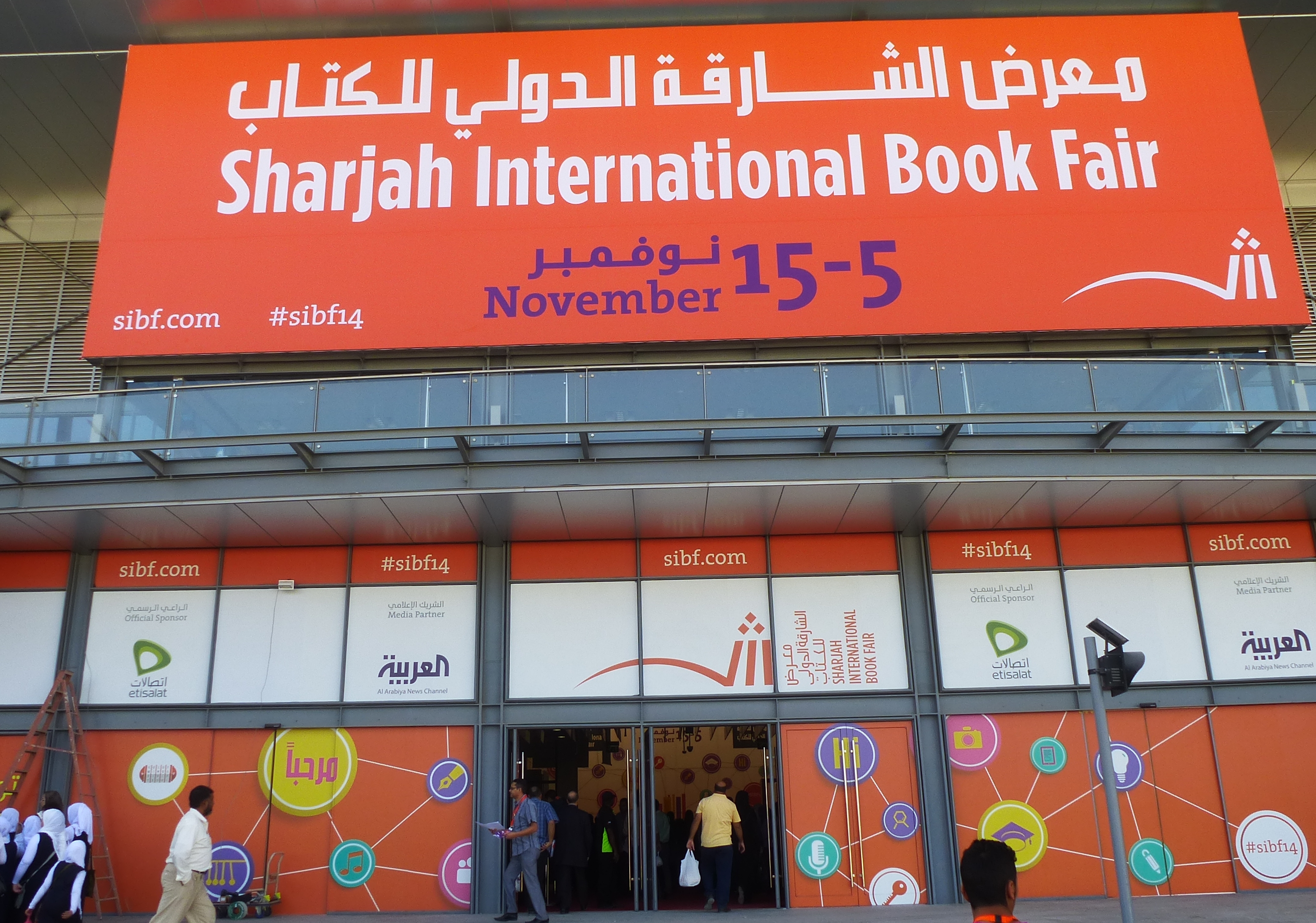
book fair entrance

I’ve been back from Sharjah three days, and still haven’t updated my blog. There’s no good excuse. I caught myself up on missed episodes of The Walking Dead (I knew he was a fake) and Doctor Who (I didn’t understand any of that last episode), so now my evening schedule is clear for this. (Links to day One and day Two posts)

So, where did I leave off…

The evening of day two of my visit to Sharjah (UAE) I sent emails to several Emirati poets who were attending the book fair, and asked if they’d grant me interviews.  I came to the country with an idea to write about poetry from this region, but “this region” is a big vague chunk. Narrowing the goal down to Emirati (go here to learn what being an Emirati means) poets made the most sense since their poetry culture seemed so rich here (one of the most popular TV shows in the country is a poetry contest show called Millions Poet). Within two hours after sending the emails, three of the poets had replied, and the fourth replied by morning.

The next day, after breakfast in the hotel (they serve beef bacon, which looks like pastrami, instead of pork bacon, and tastes nothing like bacon) I asked my driver (each of the guest writers was assigned a driver) to take me back to the book fair so I could track down those poets.  I felt like a bit of a stalker, walking around the convention center to blindly interrogate writers, but this is one of the main reasons I was here.

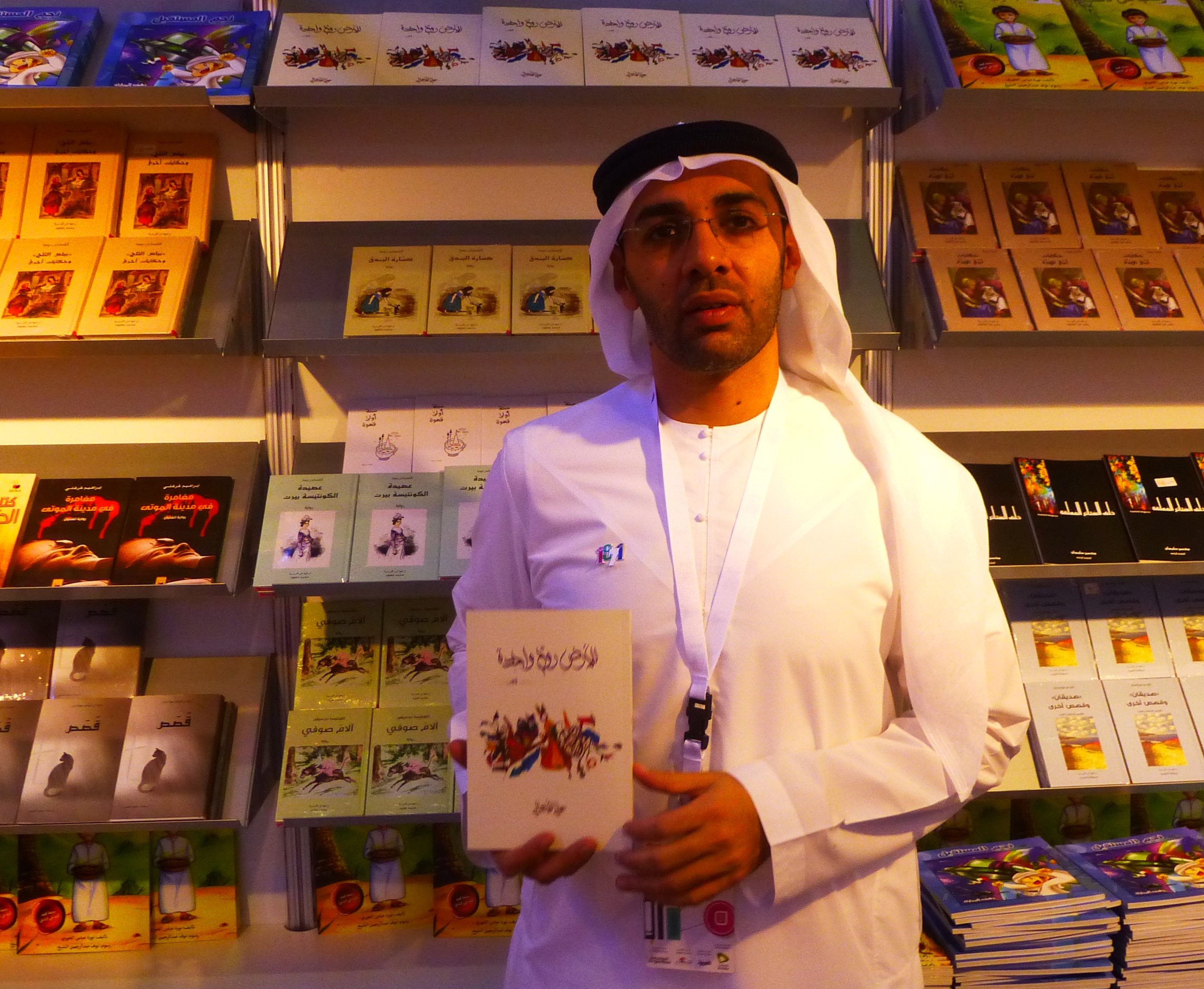
Ali Al Shaali 2First I met with Ali Al Shaali. Al Shaali studied engineering and is also a publisher himself, mostly of books for young adults. We spoke about poetry’s place in the Arabic world in general, and in the Emirates specifically. While explaining that poetry is very deeply rooted in the culture “we decorate our homes with it,” he said, he also noted that novels, TV and other media have replaced poetry for a lot of people.  “This has been the case for poetry since the dawn of history, and I’m not worried about it.”  However, he pointed out that poetry has a particularly strong supporter in the country—the ruler of Dubai and vice president of the UAE is a poet and has published books (I bought one while at the fair).
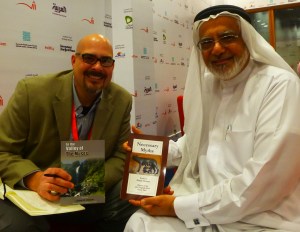
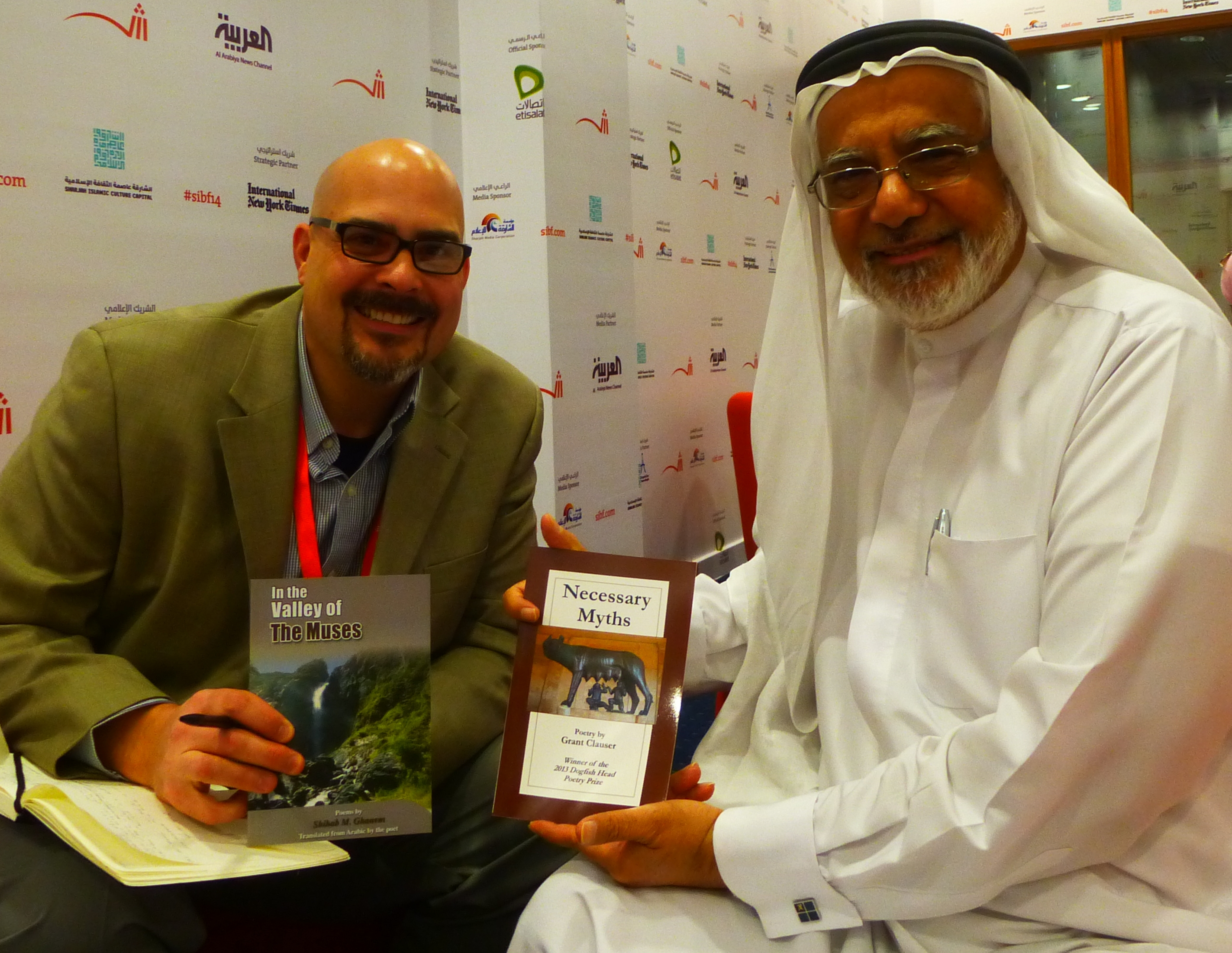
Me andGhanem 2Next I was lucky enough to meet with Shihab Ghanem, who happens to also be an engineer with degrees from the UK. Ghanem is a well-known poet in the UAE, and knows most of the other significant poets. In addition to his own poems, he’s translated several English language poets (Frost and Auden are two he mentioned to me) into Arabic. He’s also a key person in an annual poetry festival held in Dubai called The Poetic Heart.

My third poet/engineer of the day was Talal Salim. That pattern is actually pretty common. In the UAE, and in the rest of the Arab world, the path to being a writer doesn’t involve creative writing classes and MFAs. That’s mostly an American phenomenon. People come to poetry writing more organically here. Sometimes through university study of Arabic literature, but mostly by just its infusion in life. All of the writers I spoke to that week became hooked on poetry as school children, and continued to immerse themselves in it alongside their other careers and studies. Why don’t we have more poet-engineers in the US?

* * *

Sheikha Al-MutairiThe next day I had two women Emirati poets on my list. Back to the book fair I went. The first was Sheikha Al-Mutairi (photo on the right). Unlike the previous day’s interviewees, Al-Mutairi specialized in Arabic literature in college.

Next was a meeting with Salha Ghabish, who in addition to being a poet, has been a magazine editor, has published plays, a novel and done radio and TV. Ghabish’s English was a little rusty, so Noura Al Noman, an Arabic sci-fi novelist, helped with translation.

These interviews, in case you’re wondering, are all for an article that will be published later in a US poetry magazine. I’m not including details from the interviews here, because I want to save them for the article.

The next day, Thursday, was my last full day in Sharjah, and a free day. I spent the afternoon visiting museums, walking around the city and being a tourist. In the evening, Hamza Qenawy, a journalist for the arts and culture magazine Dubai Al Thakafiya, met me in the hotel lobby for an interview about my own poetry. Unfortunately for me, the magazine is published only in Arabic, so I won’t be able to read the piece when it comes out.P1020582

In addition to the local writers already mentioned, the book fair introduced me to other guest writers from around the world. Altogether, it was a pretty amazing week.

I’m very grateful to the Sharjah Book Fair for inviting and hosting me for this event, and for the time and attention the writers I met there granted me.


Twitter with me @uniambic
Sharjah Book Fair Day 2: Kids and Camels

Kids at bookfairMy second day in Sharjah included only a little book fair activity. After breakfast I headed over to the expo center to wander around and hopefully connect with some local poets for an article I’m planning. It turned out that Sunday morning (weekends in UAE are Friday and Saturday) was for school children. The parking lot was crowded with school buses, and the fair halls were thronged with kids. Most of the kids were in uniforms or traditional Arab clothing (I haven’t yet sorted out which outfits mean what—but that’s on my list of things to learn).

While at home it’s rare to see many children at a book store (maybe because we shop at Amazon), here thousands of kids tore through the book fair like hurricanes, paging through books, scattering them over tables, waving them at booksellers asking for prices, and spilling a little ice cream or drinks on the floor.  I was chatting with an Indian bookseller in his booth when a group of kids charged in. “I have no books for children,” he said as he shuffled them off and back down the hall.

Like kids everywhere, they seemed to congregate around comic books, animal books, and anything related to super heroes or Disney characters. Many sellers offered illustrated books about Islam, and there were usually groups of kids paging through those.

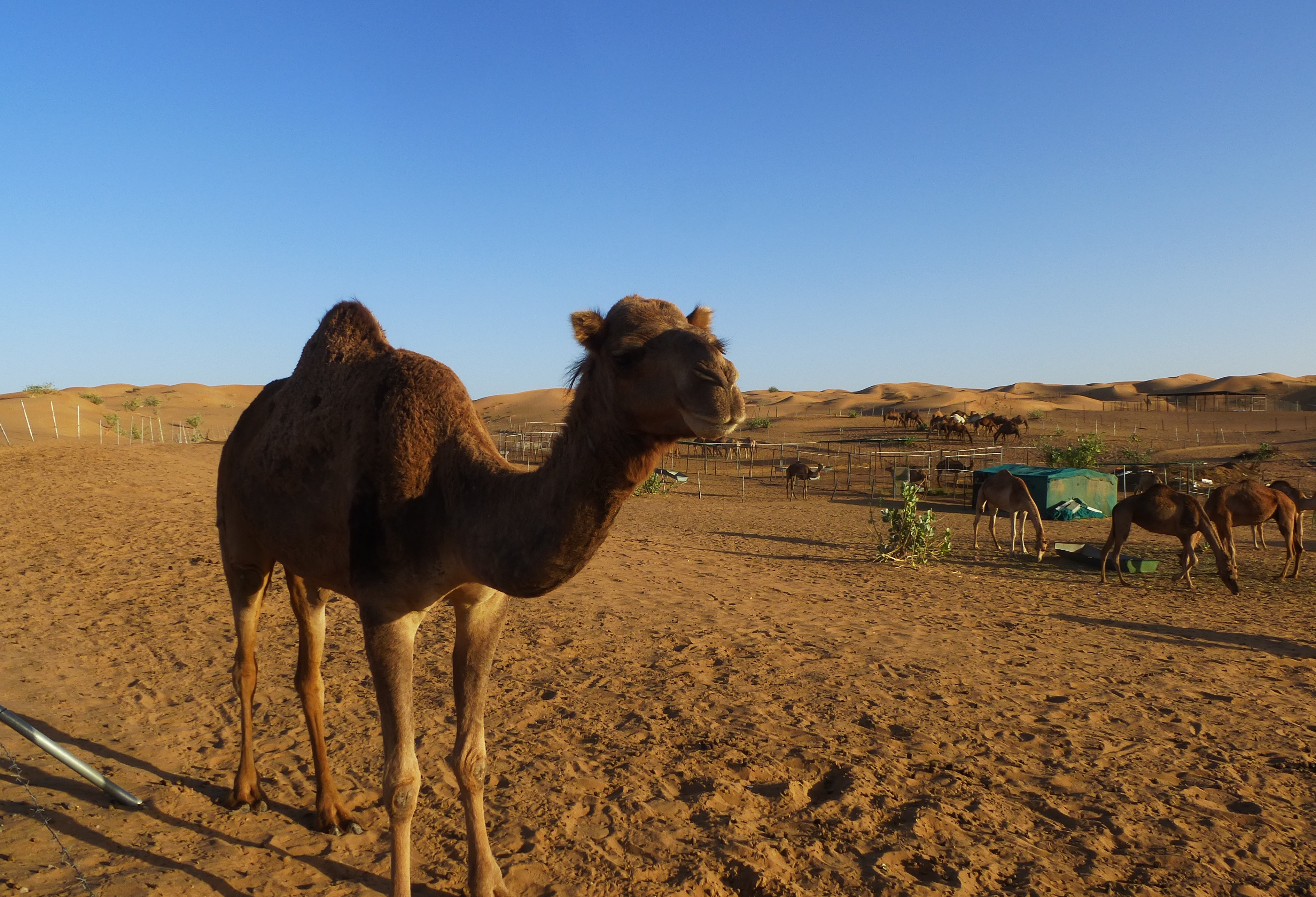
After leaving the book fair I joined a group of other invited writers (from Pakistan, Germany, India, China, Australia and more) for a desert adventure. We drove about an hour outside of the city where the landscape turned into waving dunes, date trees and small desert bushes. When we arrived at our destination, the drivers let about half the air out of the tires of the 4x4s and took us for a roller coaster drive over the dunes. One of the land rovers got temporarily stuck atop a dune precipice and needed to be pulled off by one of the other trucks.

camel farm

After dune bashing for a while, all the Land Rovers parked, and our attendants rolled carpets over the sand and set up a tent to serve coffee while we were given a demonstration of Bedouin falconry. It wasn’t too much longer  before the sun dropped below the dunes.

A good dinner of shish kebobs and some camel rides later, and we piled into the vehicles for the ride back to the city.

dune evening


Sharjah Book Fair Day 1: Arrival, Form Panel, Dinner

Form poetry panel group 1This week I’m particularly thrilled to be a guest author of the Sharjah International Book Fair in the United Arab Emirates. Book fairs are a big attraction in the UAE, and the annual event in Sharjah is the biggest of them. Throughout the week I’ll post updates on my experiences here.

Day one started with my arrival at the Dubai airport early in the morning after 13 or so hours of flying (with very little sleep, though I did watch about 8 hours of season 2 of Vikings). When I finally arrived at the hotel (and found a welcome package with dates and flowers waiting for me) I went right to bed.

My first and only Book Fair event of the day was an evening panel discussion on the relationship of form and content in poetry. I shared the panel with Gaza-born poet Na’ima Hasan  and Yousef Abolouz, winner of the Arab Literary Award from the Jordan Writers’ Union. The session was moderated by poet Hamza Qannawi.

I’m afraid to admit, that even with a translator speaking the English words into my wireless earphones, I had difficulty following the other presentations. A big problem is that literary translation can’t be done on the fly, so at one point the translator simply stopped trying. In my own presentation, I discussed the approach to form in two different ways. The first was about form in the classical sense of the word (meter, lineation, stanza structure) and how making those structural choice early in the poem is an important aid to the poet during composition because it takes some of the decision-making element out of the process and can influence, or even force, language choice.

The other kind of form I referred to is more of what I call the purpose-built poem—from as function. Poems that are purpose built to perform a specific function (odes, elegies, letter poems, praise poems…) also aid the writer by restricting choices. Those kinds of forms have built-in goals (though they can be vague goals), audiences, and voices, which all contribute to the content/meaning layer of the poems.

Based on the questions from the audience, and the conversations I had with listeners afterword, I think the talk went over fairly well. I hope jetlag didn’t make me incoherent.

After the panel I went out to dinner with my old college friends Farid and Omer and the writer Saba Imtiaz at the best Thai restaurant in the UAE.

There will be more to report on tomorrow as I plan to spend more time at the book fair and hope to do some interviews with poets I meet.


Writing Process Blog Tour

I need to thank Christine Brandel for inviting me to this writing process blog tour. Please check out her excellent site CLBwrites and see what she’s up to.

Now, onto the questions

What are you working on?

I recently finished up a new poetry manuscript and am starting to send that out to book contests and trying not to think about all the $25 reading fees. A few weeks ago I started a sort-of series of poems that’s sort of a metaphysical bestiary. I also hope to spend time on a long-term project with fishing illustrator Jason Borger. When it’s done, Lucia Press will produce a fine art book of Borger’s prints and my poems. His beautiful fish pictures are done, but I’m not even halfway through writing the poems to compliment the images. I’ve also been collecting and studying odes, classic and new, for a 2-day class I’m teaching in November at Musehouse (you can still sign up here). Some of my own odes will be appearing soon in Gargoyle and Superstition Review.

Also, I’m pretty excited about a trip coming up soon to the Sharjah International Book Fair in the United Arab Emirates. I’ll be on a poetry panel or two, do some readings and browse around meeting writers from all over the world.

How does your work differ from others in the genre?

On the genre level, it probably doesn’t differ a whole lot. I write poems that look like poems and can’t really get confused with clay pots or oriental rugs. However, I hope my poems distinguish themselves in voice and attitude. A reviewer not too long ago called my poetry “old fashioned and audacious,” and I like that.

Why do you write what you do?

I was initially attracted to poetry in 6th or 7th grade when I memorized The Raven. I like the rhythms, images and mystery of it. Those are characteristics I’m still drawn to, and features that I think poetry does best. Also, I have a very short attention span and can’t write long-form creatively.

How does your writing process work?

Usually I start with an image, word or phrase I like. Sometimes that phrase is in the form of a title. I keep a file of lines and titles that occur to me, and a couple of times a week I’ll go to that file and pick out something to work with. Then I just let each line tell me what to put in the next one, so hopefully the poem has a natural, self-generative feel to it. I also tinker with my new poems a lot in the first few days, and if it doesn’t keep my attention longer than that, I’ll probably forget about it. I never save separate drafts; I just save over the prior one, not really caring if I lose something in the process.

For the past year and a half I’ve been doing a lot of what you might call project poetry—poems who’s themes or situations were all planned out in advance. That’s not something I’d ever done before, but I like the results so far. We’ll see if the book gets published.

While I don’t like to use prompts (I assign them in workshops though), I do get a lot of ideas from reading other poems. I especially like response poems in which I write a response to some other poem. I also just plain steal small ideas (and credit the original of course). In fact, once I wrote a poem about finding some other poet’s line in my poem. I’m sure it was an accident.

Check out Christine Brandel’s Writing Process post, click here.

Twitter with me @uniambic

Philadelphia Stories Reviews Necessary Myths

I was thrilled to check into Facebook this morning and see that Philadelphia Stories magazine had posted a new review of my book Necessary Myths. In the review Peter Baroth says:

Clauser is a master of wordcraft. There is a kind of late afternoon buzz quality to his descriptions of nature – even in PSSummerCoverits impermanence. I can definitely see the sun setting on so much of what he describes where we can find such things as “a gossiping spring between rocks…” (“The Children Discover a Spring Between Rocks”). And also perhaps, ever so vaguely, there is a yearning for a terribly remote and tenuous unfallen past. A garden that was probably already beginning to petrify moments after its creation.

Read the entire review here.

On twitter @uniambic

12 Books: A Poetry Nerd’s Poetics Reading List

I recently finished up leading a poetry workshop at a writers’ retreat at Rosemont College near Philadelphia. During one of the classes, populated mostly by MFA graduate students, I brought in a pile of craft/theory/poetics/rant books. I’m a nerd for books about poetry and interviews with poets (I always turn to the interview section first when a new issue of Rattle arrives). Aside from reading lots and lots of poetry, one of the best ways for me to learn more about poetry is through reading poets talk about their own processes and ideas. Here’s a partial list of books I think should be on every poet’s shelf. I’m offering this list here for the retreat students who didn’t get to write down the names of all the titles they were interested in.

Please add more books in the comments section if you think I’ve left out something important or interesting. There’s no particular order of importance in the way I’ve assembled this list, and I may add more as I find things on my shelves.

Writing Poems by Robert Wallace. Harper Collins.
I came to this, as I do with a lot of craft books, first as a fan of Wallace’s own poetry. This book is an excellent hardcore treatise in the basic principles and how they work within poems. Lots of samples and some writing prompts.

Proofs & Theories: Essays on Poetry by Louise Gluck. Ecco.
Here’s a book I love to argue with, which makes the process of reading it fun (and why my copy is so full of scribbled notations). Gluck’s book mixes essays on composition theory with comments of specific poets (Eliot, Oppen, Kunitz). The essay I marked up most is “Against Sincerity.”

Poetry in Person, Twenty-five Years of Conversation with American Poets Edited by Alexander Neubauer. Knopf.
This book is mesmerizing. In it you find 23 transcripts of poets talking with teacher Pearl London and her creative writing classes. These aren’t just any poets though—we get to eavesdrop on Maxine Kumin, Robert Hass, Philip Levine, Galway Kinnell, Lucille Clifton, Li-Young Lee, Charles Simic…

The Poet’s Companion: A Guide to the Pleasures of Writing Poetry by Kim Addonizio and Dorianne Laux. Norton.
This is a very practical and easy to love book on craft. It’s designed more for people who are new to writing poetry, but it also has plenty of insights for established writers. It would make a great textbook for a creative writing class. Lots of prompts and examples are provided. Engagingly written.

Nine Gates: Entering the Mind of Poetry Essays by Jane Hirshfield. Harper Perennial.
I first came to this book, 1) as a fan of Jane Hirshfield’s poems and 2) because I was looking for new ways to think about nature poetry, and Hirshfield suggest I read her essay Two Secrets which is collected here. This book is a mix of theory, craft and philosophy—particularly zen.

The Sound of Poetry by Robert Pinsky. FSG.
Here’s a book that really tries to bring back respect for sound and texture in poetry. Good information, but ironically it’s a bit of a flat read.

Best Words, Best Order by Stephen Dobyns. St. Martins Press.
This should be required on every new MFA student’s shelf. I particularly like chapter 5: Pacing: The Way a Poem Moves.

The Triggering Town by Richard Hugo. Norton.
Any fan of Richard Hugo’s poems probably already knows about this book. On one level it’s a guide on how to write like Richard Hugo, but it’s much more than that. For the beginning poet, he makes poetry less intimidating and more personal, but for the mature writer, there will also be a lot of shared “ah ha” moments. Get this book.

Lofty Dogmas: Poets of Poetics. edited by Deborah Brown, Annie Finch and Maxine Kumin.
This is one of my favorites, and I’d love to teach a class with this as the text book. It compiles essays from ancient times (Horace) to contemporary poets, discussing issues of inspiration, craft and poetry culture. Many of the most important essays on poetry are all wedged in here.

Close Calls with Nonsense: Reading New Poetry Essays by Stephanie Burt. Graywolf.
This collection, all republished from literary journals, attempts to explain and support the work of what Burt calls the elliptical poets—poets like Rae Armantrout, CD Wright, John Ashbery, Lorine Niedecker and others. Often, for me, the support Burt uses doesn’t hold up, but I appreciate it nonetheless. If you’re a fan on this kind of poetry, you’ll find a lot to like here. If you’re not a fan, this book will at least help you understand what they’re trying to do.

The Art of Syntax: Rhythm of Thought, Rhythm of Song by Ellen Bryant Voight. Graywolf.
There are (I think) seven volumes in The Art of series. Of the five I have, this one is my favorite. It offers clear explanations of how sound and texture affect poetry. My other favorite in the series it Dean Young’s The Art of Recklessness.

Temporary Shelters is now available at Bookshop and Amazon.

New Review of Necessary Myths

The online literary pub Pedestal has published a new review of my book Necessary Myths. I’m flattered and honored by the response.

The reviewer says:

“Throughout Clauser’s book, we encounter this implicit prescription—we must go on with our daily work of being alive, no matter. Like a river, we proceed, sometimes wild, sometimes calm. Clauser gives us that much hope. Reminiscent of the American philosopher Henry Bugbee, he shows us the importance of place, of tasks, and of nature. His poems are imbued with a similar Western-Taoist worldview. It strikes me that Clauser is both old-fashioned and incredibly audacious.”

Find the rest of the review here.


follow on Twitter @uniambic

Poet Bill Knott has Died

A few sources on the internet have reported that Bill Knott passed away Mach 12 due to complications from heart surgery.

Death

by Bill Knott

Going to sleep, I cross my hands on my chest.

They will place my hands like this.

It will look as though I am flying into myself.

__________________________________

Here’s a selection of links to articles, interviews and other Bill Knott info:

Bill Knott’s blog about poetry rejection (includes scan of many rejection slips and letters).

Article on HTML Giant about his selected poems, which was to be published by FSG but he later gave it away for free as a download.

Richard Hell on Bill Knott

Bill Knott was also a painter. Here are some of his painting.

BookSlut interview with Bill Knott in which he calls Basil Bunting’s Briggflats his least favorite poem.

A Wikipedia entry that says almost nothing

A quite lengthy and interesting article on Bill Knott by John Cotter

An interview with Bill Knott on Memorious in which he talks a lot about publishing and rejection.

Something from The Rumpus

Thomas Lux is a big fan of Bill Knott


___

Follow on Twitter @uniambic