Pennsylvania is teeming with exceptional poets. One of my favorites, and one of the first poets I connected with, is Harry Humes. I was first introduced to Harry by Dick Savage, a professor in the English Department of Bloomsburg University when I was there in the 80s, who also served as an informal mentor to both of us (though many years apart). While at BU I met Harry at a writing festival at nearby Bucknell University, and we’ve met up and corresponded from time to time since then. We both share a love of the wilder places in Pennsylvania, particularly the state’s mountains, rivers and streams–which we both stalk with fly rods for trout.
Harry earned an MFA in poetry at the University of North Carolina Greensboro in 1967. He taught in the English dept. at Kutztown University, and currently teaches a fiction writing class at Cedar Crest College.
Harry’s work has been featured in numerous journals and the Best American Poetry 1997. He’s been awarded a Theodore Roethke Poetry Prize, National Endowment for the Arts fellowship, Devins Award and others. For many years he also ran the poetry journal Yarrow.
What is it about revisiting past events that they become triggers for your poems?
I think mine live inside of me. That’s to say that Girardville is always there. It doesn’t drag me down; it’s just rich. Growing up in a place for 20 years, everything you know, everything you found out about, you learned one way or another in the first 20 years of your life. All the important stuff is there. I didn’t think I was paying a whole lot of attention to things when I was growing up, but obviously I was paying attention.
As poets, we’re consciously paying attention to things, looking for material, but as kids you don’t think that in 20 or 30 years these events will become poems. Is recreating past events and details a challenge? Is there embellishment?
Oh yes, I make things up a lot. I start with something that happened, but then sometimes I lose interest in it, so I start inventing things about it and other people. I’ve imagined a lot of things that didn’t happen but could have happened.
Girardville was a wonderful place to grow up for a kid, but it was also very dramatic and dangerous. The mines were there, the mountains… we just roamed around like crazy. My mother had to worry about her husband going out to the mines every day. So anyway it was profoundly there. I didn’t think about it for years… I had some dead-end jobs and then got drafted, and when I got out of the army and went to school and began thinking (and that’s when I met Dick Savage) that maybe I could do something with that experience. But I didn’t starting thinking about the coal mining poems, the father poems, until many years afterword and started mining that material for poems. I had been writing about fishing and nature, girlfriends and so forth. But later the town became central.
I lived in the coal valley, and it was torn up. There were trucks and trains and so forth, but right over the mountain I could hike out of my valley over the top and down into this agricultural valley. There was a clean trout stream running through the middle of it, and it had fields. And there was no coal mine. Sometimes I’d fish or sometimes I’d just mess around, and then I’d hike back over the mountain back to my valley. So this gave me two landscapes. I had the coal mining landscape and the other landscape. Those two are my dominate landscape, and the people in them. So I’m constantly in nature. Dick and I talked about this a lot, that what we find in nature is more than pretty flowers; it’s something else. He introduced me to Wordsworth and Blake and the others early on.
You mention the dangerous and dark environment of the mining valley and the green and light farming valley. I noticed a lot of duality in some of your poems? Was that an approach you established early in your writing?
It took me a long time. After Bloomsburg I went to the University of North Carolina and the MFA program. I thought then I’d bitten off more than I could chew because these guys [the other students] had been writing for a long time. But I developed a whole lot in those two years. It took me forever to learn how to do it. I tell my students don’t even think about doing anything serious for the first 10 years. Gerry Stern used to say “read a hundred books, then write a poem.”
Process? It just sort of happened. It just poured for about 15 years. Something became unplugged. I think something in me knew not to get to the good stuff until I was able to write about the good stuff. Then they all came out. Over a period of 15 or 20 years they all came out. Now I fiddle around. I didn’t think too much about process. For a while I thought about writing in form. I wrote in form and meter and rhyme and published some, but then went back to the free verse stuff and never looked back.
Talking about beginnings, middle and ends–endings have always been hard for me, they still are and come harder now than they used to. Metaphor was always there. When the plug got pulled there was a torrent of metaphors and imagery.
I’ve never been quite sure when I’m writing a poem what I’m doing. It’s like fishing. You know what you’re doing because you’ve been fishing in the water and you see things in the water… but I write, and then things have an instinctive way of happening. I’ve started poems about one subject and they morph into something else, because something in the poem said change the subject. And it’s like that with endings. I’ll get near the end, but it might take me another week or two to come up with the right lines to end it. It’s like looking at a piece of water and just knowing there’s a fish in there. All you’ve gotta do is just fuck around long enough to get him out one way or another.
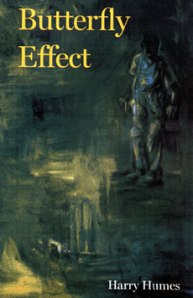
Butterfly Effect, a 1998 National Poetry Series selection.
Yes, that’s exactly right. Every now and then I’ve tried to write a sequence of poems, and I’ve never been able to do it. I get two or three poems out in the sequence, but then it starts to fade. I lose interest. Poems come to me from nowhere. There seems to be no rhyme or reason for why they turn up. I’ll be looking at a corn field and something will come to me. It’s often about wherever I happen to be.
I was fishing on the Little Lehigh last night and had a good hour and a little sulfur hatch, and I put on a comparadun fly, and so there I was fishing and thought, “This is pretty nice. Maybe I’ll write a poem about this.” and then I thought “don’t write another fishing poem.” So poems just happen. I don’t go looking for them. Sometimes I think I’ve got two sets of eyes. One is for living and one is for looking for poems.
A lot of your poems deal with some work or craft, someone building something or working with tools. Is because those are part of the memories or preserving something of a lifestyle we don’t really have anymore?
I have things in my room here that belonged to my father. I use his hammers and saws that he never let me use as a kid. I have a poem now that I’ve been playing around with about a cellar door. It was the house in Girardville and inside the door were the knee-high mining boots that he used to wear. So yes, tales like that I love to bring into poems. I try to get my students to think of things. We live in a world of things, and that’s what makes a poem alive for me.
Many of your poems have a journey—hiking to a swamp or crossing a mountain—that can seem almost mythic. Are you using these places as vehicles to explore an inner world as well?
Sure. I think anyone who writes does that. I did a poem last year called Climbing the Wall. We used to a lot of climbing on the slate walls after the coal had been taken out. It was very dangerous. I had to climb over those walls in order to fish in the valley on the other side. So I played around with that.
Anyway, sure, swimming, hiking, the journey metaphor is there. The other day we were up on Hawk Mountain, and the journey of the hawks is always quite stirring for me, so I wrote a poem about it of course. You go from here to there, and that’s our life.
When it comes time to assemble a collection into a book, what do you consider when deciding what to include and how to order it?
I’m in that process now. I have about 50 poems that I didn’t think were going to go anywhere and over the last couple of week’s I’ve been looking at them and thinking maybe they could be a book. So I’m looking at them again, and eventually I’ll get around to putting them all over the living room floor. Again, it’s instinctive. It’s like writing the poem in the first place. I know the way the poems should come together, I know what I’m looking for, but I don’t know that I know. The hardest one was my first one, Winter Weeds. It’s a long process, and I’ll probably spend another six months deciding what poems I want to keep and what I want to throw away. You have to make hard choices sometimes. If there’s the least little thing I’m not satisfied with in a poem, I put it in the maybe pile. It’s like knowing there’s a little misfire in a motorcycle engine—something isn’t working. I don’t think in terms of a collection when I’m writing. I think of the poem.

 Philip Dacey is the author of twelve books of poetry, most recently Gimme Five (2013), the winner of the Blue Light Press Book Award. The recipient of three Pushcart Prizes, two NEA grants, and a Fulbright