Poetry Reading Q & As

Over at the Potomac Review blog there’s a great post about the etiquette for Q & A sessions following poetry readings. I usually like Q & A sessions better than the open reading sessions following a reading, if the questions are good. Sometimes they’re not, and this post explains a few ways they can go badly.

To that list of don’ts I’d add one more: don’t use your question as a way to show off how much you know (or think you know) about the poet or poetry. Ask a question. Don’t make a speech. Read the Potomac Review post here.

And here are some more of my own thoughts on poetry readings.

Review: Seven Places In America by Miriam Sagan

seven places coverFrequently while reading Miriam Sagan’s latest poetry collection, Seven Places in America, I was struck with waves of jealousy. The book is constructed around her journeys and residencies at what, at least through her writing, must be some of the most wonderful places in the country for a poet to meditate on things great and small. This is especially true for a poet like Sagan, who has an affinity for the more rustic or natural places.

Some of these places were official writers’ retreats, while others were just places that accommodated her, and she accommodated them. Either way, she made the most of these visits, as good writers can, by using the foregrounds and backdrops as gateways for her poems to pass through or stretch out within. Her poems ride “the boat of the mind/that floats on air” tacking through waterways looking for purchase. When they land on hard ground, you know it, as in “10,000 Islands,” part of a series titled Ever/Glade (which, incidentally, made me think of Karen Russell’s novel Swamplandia.

I longed for departure

As if it were love

As if it would take me out

Of myself, of my accustomed way—

Sandbar of white pelicans

Lifts off, wheels into the sun

Silver flash of fish before the prow

Maze of low islands, one after the other,

Gives way

to open water.

Do you see what she did there? The very quiet leap from the silent meditation of longing for departure to the dramatic scene of birds rising and a boat rushing among islands. For me, these poems are at their strongest when she uses her environment as the A in an ongoing Q & A with themselves.

While I found poems to relish throughout the book, I think my favorites are in part V, which were written at Stone Quarry Hill Art Park in Cazenovia, New York. Maybe being a Pennsylvanian drew me to these poems as they describe scenery very like my own home.

In the first poem in that section, Sagan uses, with dramatic effect, the refrain “body of” in a chant-like list of things you might find in any eastern woodland.

meadowlark

body of liberties

forest

body of knowledge

dream

body of research

fireflies

body of principals

That’s fun, as are a lot of the poems in this book. You can feel the author’s delight coming off the page. At the same time, there are also haunting moments, such as in “Tree House,” where the speaker reflects in attendant language (“The creaks and meows of night,/Shadows of the copper beeches.”) on the material landscape of a childhood while simultaneously acknowledging the psychological landscape.

There were moments I thought the poet may have fallen into her own traps—pushed a metaphor a little too far, took the readers’ trust for granted, but then come moments of wonderful self-awareness, as if she knows where she’s taking us and is grinning a little inside, like here, in the poem “Stone Quarry Hill”:

If this poem were Chinese

I’d say my hair is gray (which it is)

And that I haven’t heard

News of you in a long time.

If I’m being played, I’m OK with it. Even when she asks “Why must inspiration be a vista?” you know she knows the answer is more complicated than that. “An inner self/that also shifts shape” is the visita we’re really meant to contemplate: “how what we ignored or couldn’t explain/remained in plain view.”
Interview with Me for Missouri Writers’ Conference

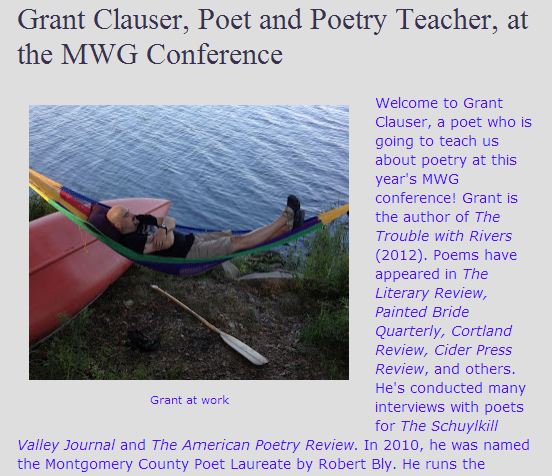
MWC interview grant ClauserIn April I’m traveling to Missouri for the 2013 Missouri Writers’ Conference. I’ll be teaching two sessions there, a one-hour session called Core Issues and a longer, three hour, session called Building Trustworthy Poems. You can learn more about and register for the conference here.

To help promote the confernence, Margo Dill conducted an interview, which you can see here.

RIP Jack Gilbert “Silent and wonderfully content”

Image

One of American’s most beautiful poets, Jack Gilbert, has passed away. He was 87. He is easily the most important poet to me as a reader and as a writer.

WAKING AT NIGHT

The blue river is gray at morning

and evening. There is twilight

at dawn and dusk. I lie in the dark

wondering if this quiet in me now

is a beginning or an end.

 (from The Dance Most of All)

Some links below:

Page on Gilbert by the Academy of American Poets

Notes from a Poet’s Well-Observed Life (NPR)

Chard deNiord’s interview with Jack Gilbert.

David Orr’s review of Gilbert’s Collected Poems

LA Times feature on Jack Gilbert

Poetry Foundation page on Gilbert

A Paris Review interview from 2005  (required reading)

Poem “A Brief for the Defense”

Today’s Poetry Rules

When writing, I keep to a handful of rules, something to guide my work, like a handrail on a woods trail. I also have a tendency to change my rules when they no longer suite me. Here are today’s, which may be different from tomorrow’s:

  1. Don’t be boring. This is a big deal for me, but I assume I don’t live up to it on many occasions. I attend a fair amount of poetry readings and read a couple hours worth of poetry almost every day, so I know something about boring poems. Subject matter can be boring, language can be boring, titles can be boring. Today I’ll try use a lot of “t”s in my poems, because I think “t” is an unboring letter. We had a big storm earlier this week, you may have heard of it. Storms are not boring. The opposite of boring isn’t interesting, it’s just unboring. Mysterious, engaging, sympathetic, sentimental, dangerous, threatening, disturbing… are all unboring.
  1. Be trustworthy. A poem is an invitation to the reader—you want the reader to enter your world, point-of-view, sick mind or private delirium. If you don’t create a sense of trust, the reader won’t be engaged.
  1. Have a reader in mind. My first reader is my imaginary friend, and he’s a lot like me (but thinner and with more money and friends). Keeping a reader in mind leads to writing that is more trustworthy and has a clearer voice. Voice is purpose, and purpose implies audience. If you shout “piss off” into the air, it just floats away without purpose. If you shout “piss off” at your boss, it has purpose and voice. It also gets you fired, so have a backup plan for that.
  1. Always be nice to dogs.
  1. Don’t fear sentimentality. I’m a sap. I watch “It’s a Wonderful Life” every December and will until my eyes are donated to science. People love that movie because they’re spineless and easily moved (me too). Work with it.
  1. Don’t try to teach something. You’ll be annoying, and people will think you think you’re smarter than them. Try to learn something instead. I believe poems, the good ones, are not for expressing something; they’re for sorting something(s) out.
  1. Shoot for clarity, but figure you’ll miss a good part of the time. When I’m fly fishing, I always have a spot on the water I try to hit with my casts. I usually miss, but often still catch fish. I also get snagged in a lot of trees. That’s the difference between almost clarity and complete abandonment.
  1. Sleep experts tell us that even complex dreams only last seconds—so poems shouldn’t be long.
  1. Don’t write dream poems. They’re boring, unless Richard Hugo is writing them, and since he isn’t writing them anymore, neither should you. Fiction writer Tana French agrees with me.
  1. If all else fails, throw it away and write another. Poems are cheap.