Interview with Poet Harry Humes

harry-humes BWPennsylvania is teeming with exceptional poets. One of my favorites, and one of the first poets I connected with, is Harry Humes. I was first introduced to Harry by Dick Savage, a professor in the English Department of Bloomsburg University when I was there in the 80s, who also served as an informal mentor to both of us  (though many years apart). While at BU I met Harry at a writing festival at nearby Bucknell University, and we’ve met up and corresponded from time to time since then. We both share a love of the wilder places in Pennsylvania, particularly the state’s mountains, rivers and streams–which we both stalk with fly rods for trout.

Harry earned an MFA in poetry at the University of North Carolina Greensboro in 1967. He taught in the English dept. at Kutztown University, and currently teaches a fiction writing class at Cedar Crest College.

Harry’s work has been featured in numerous journals and the Best American Poetry 1997. He’s been awarded a Theodore Roethke Poetry Prize, National Endowment for the Arts fellowship, Devins Award and others. For many years he also ran the poetry journal Yarrow.

What is it about revisiting past events that they become triggers for your poems?

I think mine live inside of me. That’s to say that Girardville is always there. It doesn’t drag me down; it’s just rich. Growing up in a place for 20 years, everything you know, everything you found out about, you learned one way or another in the first 20 years of your life. All the important stuff is there. I didn’t think I was paying a whole lot of attention to things when I was growing up, but obviously I was paying attention.

As poets, we’re consciously paying attention to things, looking for material, but as kids you don’t think that in 20 or 30 years these events will become poems. Is recreating past events and details a challenge? Is there embellishment?

Oh yes, I make things up a lot. I start with something that happened, but then sometimes I lose interest in it, so I start inventing things about it and other people. I’ve imagined a lot of things that didn’t happen but could have happened.

Girardville was a wonderful place to grow up for a kid, but it was also very dramatic and dangerous. The mines were there, the mountains… we just roamed around like crazy. My mother had to worry about her husband going out to the mines every day. So anyway it was profoundly there. I didn’t think about it for years… I had some dead-end jobs and then got drafted, and when I got out of the army and went to school and began thinking (and that’s when I met Dick Savage) that maybe I could do something with that experience. But I didn’t starting thinking about the coal mining poems, the father poems, until many years afterword and started mining that material for poems. I had been writing about fishing and nature, girlfriends and so forth. But later the town became central.

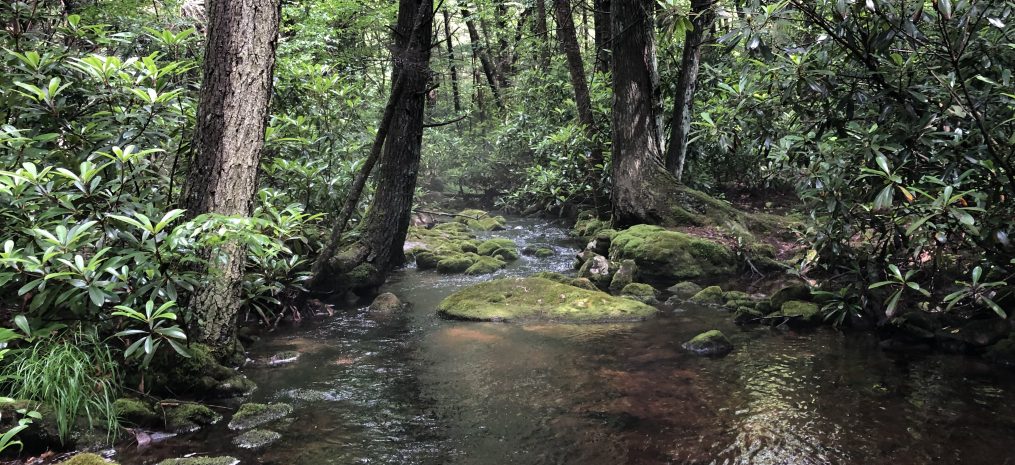
I lived in the coal valley, and it was torn up. There were trucks and trains and so forth, but right over the mountain I could hike out of my valley over the top and down into this agricultural valley. There was a clean trout stream running through the middle of it, and it had fields. And there was no coal mine. Sometimes I’d fish or sometimes I’d just mess around, and then I’d hike back over the mountain back to my valley. So this gave me two landscapes. I had the coal mining landscape and the other landscape. Those two are my dominate landscape, and the people in them. So I’m constantly in nature. Dick and I talked about this a lot, that what we find in nature is more than pretty flowers; it’s something else. He introduced me to Wordsworth and Blake and the others early on.

You mention the dangerous and dark environment of the mining valley and the green and light farming valley. I noticed a lot of duality in some of your poems? Was that an approach you established early in your writing?

It took me a long time. After Bloomsburg I went to the University of North Carolina and the MFA program. I thought then I’d bitten off more than I could chew because these guys [the other students] had been writing for a long time. But I developed a whole lot in those two years. It took me forever to learn how to do it. I tell my students don’t even think about doing anything serious for the first 10 years. Gerry Stern used to say “read a hundred books, then write a poem.”

Process? It just sort of happened. It just poured for about 15 years. Something became unplugged. I think something in me knew not to get to the good stuff until I was able to write about the good stuff. Then they all came out. Over a period of 15 or 20 years they all came out. Now I fiddle around. I didn’t think too much about process. For a while I thought about writing in form. I wrote in form and meter and rhyme and published some, but then went back to the free verse stuff and never looked back.

Talking about beginnings, middle and ends–endings have always been hard for me, they still are and come harder now than they used to. Metaphor was always there. When the plug got pulled there was a torrent of metaphors and imagery.

I’ve never been quite sure when I’m writing a poem what I’m doing. It’s like fishing. You know what you’re doing because you’ve been fishing in the water and you see things in the water… but I write, and then things have an instinctive way of happening. I’ve started poems about one subject and they morph into something else, because something in the poem said change the subject. And it’s like that with endings. I’ll get near the end, but it might take me another week or two to come up with the right lines to end it. It’s like looking at a piece of water and just knowing there’s a fish in there. All you’ve gotta do is just fuck around long enough to get him out one way or another.

butterfly-effect

Butterfly Effect, a 1998 National Poetry Series selection.

Yes, that’s exactly right. Every now and then I’ve tried to write a sequence of poems, and I’ve never been able to do it. I get two or three poems out in the sequence, but then it starts to fade. I lose interest. Poems come to me from nowhere. There seems to be no rhyme or reason for why they turn up. I’ll be looking at a corn field and something will come to me. It’s often about wherever I happen to be.

I was fishing on the Little Lehigh last night and had a good hour and a little sulfur hatch, and I put on a comparadun fly, and so there I was fishing and thought, “This is pretty nice. Maybe I’ll write a poem about this.” and then I thought “don’t write another fishing poem.” So poems just happen. I don’t go looking for them. Sometimes I think I’ve got two sets of eyes. One is for living and one is for looking for poems.

A lot of your poems deal with some work or craft, someone building something or working with tools. Is because those are part of the memories or preserving something of a lifestyle we don’t really have anymore?

I have things in my room here that belonged to my father. I use his hammers and saws that he never let me use as a kid. I have a poem now that I’ve been playing around with about a cellar door. It was the house in Girardville and inside the door were the knee-high mining boots that he used to wear. So yes, tales like that I love to bring into poems. I try to get my students to think of things. We live in a world of things, and that’s what makes a poem alive for me.

Many of your poems have a journey—hiking to a swamp or crossing a mountain—that can seem almost mythic. Are you using these places as vehicles to explore an inner world as well?

Sure. I think anyone who writes does that. I did a poem last year called Climbing the Wall. We used to a lot of climbing on the slate walls after the coal had been taken out. It was very dangerous. I had to climb over those walls in order to fish in the valley on the other side. So I played around with that.

Anyway, sure, swimming, hiking, the journey metaphor is there. The other day we were up on Hawk Mountain, and the journey of the hawks is always quite stirring for me, so I wrote a poem about it of course. You go from here to there, and that’s our life.

When it comes time to assemble a collection into a book, what do you consider when deciding what to include and how to order it?

I’m in that process now. I have about 50 poems that I didn’t think were going to go anywhere and over the last couple of week’s I’ve been looking at them and thinking maybe they could be a book. So I’m looking at them again, and eventually I’ll get around to putting them all over the living room floor. Again, it’s instinctive. It’s like writing the poem in the first place. I know the way the poems should come together, I know what I’m looking for, but I don’t know that I know. The hardest one was my first one, Winter Weeds. It’s a long process, and I’ll probably spend another six months deciding what poems I want to keep and what I want to throw away. You have to make hard choices sometimes. If there’s the least little thing I’m not satisfied with in a poem, I put it in the maybe pile. It’s like knowing there’s a little misfire in a motorcycle engine—something isn’t working. I don’t think in terms of a collection when I’m writing. I think of the poem.
Review of Sower on the Cliffs by Helen Mirkil

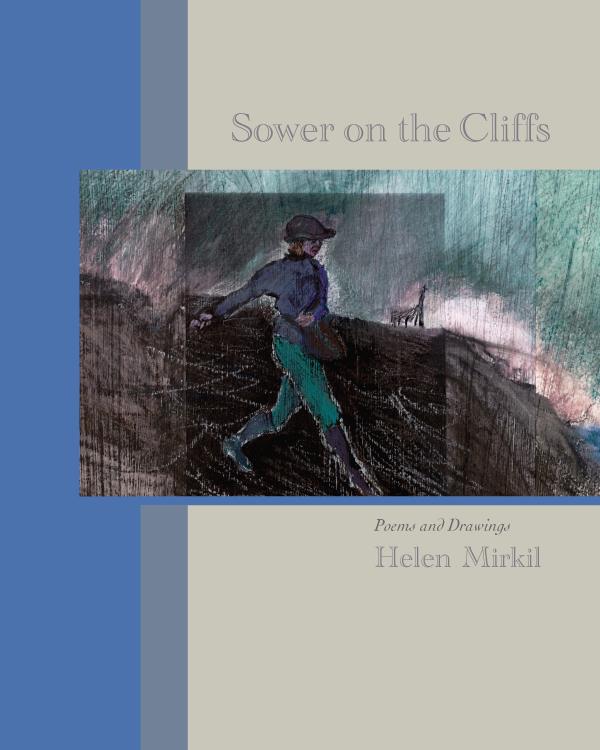
Here’s an excerpt of a review I wrote of Helen Mirkil’s new book, Sower on the Cliffs.

Soweronthecliffs_Mirkil

Sower on the Cliffs, Helen Mirkil’s book of poems and original sketches, works on the reader like one of those evening conversations over coffee where catching up with a friend has gone on for hours, yet when it’s time to call it a night, you feel like you’ve just gotten started. That’s because Mirkil’s use of language, mostly direct, gives you a sense of a door opening up before you.
The book is divided into 10 sections, each with only two to four poems bound to a theme. Many of them are family focused, some touch on losses, issues of faith and some tender moments with loved ones. Mirkil leads each section with one of her own sketches.

Like the sketches, black ink outlines, shapes and suggestions of shapes, Mirkil’s poems also follow the less-is-more approach, and that approach yields rewards as well as surprises at times. In poems like “The Station” and “Pressing In,” she offers a few details that act like an invitation for the reader to start making discoveries.

Home again. A knocking

At the screen door,

Parkinson’s. Let it in?

Read the rest of the review here at Philadelphia Stories.


The Great MFA Debate Continues

” Not knowing something is one way to be independent of it – but knowing lots of things is a better way and makes you more independent. It’s exciting and important to reject the great books, but it’s equally exciting and important to be in a conversation with them. ”


From Get a Real Degree by Elif Batuman at The London Review of Books.

Sick House at Heron Tree

I have a new (actually it’s kind of an old) poem published at Heron Tree. It’s nothing about herons or trees. The idea came from a story I heard about a family in Charleston during a yellow fever outbreak.  Don’t get too hung up on the facts.

You can read the poem here. Many thanks to the folks at Heron Tree for selecting it.

And here’s a heron photo, shot at Nockamixon State Park in Bucks County PA.

Heron at Nock cropped

Poets on Poetry: Quotes, Mostly

What would we get if accountants and waiters and bowling alley attendants talked about their occupations the way poets do? 

Anyway…

This…

“The realm of conventionally articulate speech is not sufficient for saying what needs to be said.”

Nathaniel Mackey

“Yet the very incapacity of language to match the world allows it to do service as a medium of differentiation.”

Lyn Hejinian

“A poem’s task is to seduce—its readers or listeners must find in it something irresistible, something to which they want to surrender.”

Jane Hirshfield

“For me a poem must go beyond its setting or its particular to say outright or by subtle suggestion something about the human condition. If the gift without the giver is bare, the poem without the concept is emaciated…”

Maxine Kumin

“A poem is energy transferred from where the poet got it, by way of the poem itself to, all the way to the reader. The poem itself must, at all points, be a high energy-construct and, at all points, an energy-discharge.”

Charles Olson

but…

“Concentration on technique can absorb the attention while unacknowledged material enters the language; so technique can facilitate inspiration.”

Donald Hall

and…

“One has to know his tools, so he doesn’t work against himself. Tools make the job easier. More accuracy.”

Yusef Komunyakaa

“For it is not the greatness, the intensity, of the emotion, the components, but the intensity of the artistic process, the pressure, so to speak, under which the fusion takes place, that counts.”

T.S. Eliot

“I caution against communication, because once language exists only to convey information, it is dying.”

Richard Hugo

Ah…

“Whatever else we may think of this world—it is astonishing.”

Wislawa Szymborska

Yes…

“Every good poem asks a question, and every good poet asks every question.”

Kim Addonizio

Finally:

Everything is gestation and then bringing forth… patience is everything.

Rainer Maria Rilke

Most poets write the same poem over and over.

Richard Hugo

Q & A on Writing with Lee Upton

Photo by CeCe Ziolkowsk

Photo by CeCe Ziolkowsk

In May I was invited to read poems at an art gallery in Hunterton NJ with Lee Upton, Warren Cooper and Upton’s daughter, Theodora Ziolkowski. The reading and venue were both wonderful and I hope to get back there again. I’d read Upton’s poetry before, particularly her book Civilian Histories (University of Georgia Press), but we’d never met. MaryAnn Miller, who curates the reading series, as well as publishes limited edition art & poetry books (Lucia Press), introduced us.

After the reading we chatted and exchanged books. I received a copy of her book Swallowing the Sea (Tupelo Press), a collection of essays about writing and the writing life. The issues discussed in this Q & A are based on that book.

Lee Upton is the author of twelve books, including five collections of poetry, a novella, and four books of literary criticism. Her short stories have also appeared widely. Her awards include a Pushcart Prize, the National Poetry Series Award, two awards from the Poetry Society of America, and the Miami University Novella Award. She is Writer-in-Residence and a professor of English at Lafayette College in Easton Pennsylvania.

You write “Our store of happiness is always in danger of being depleted.” Is a fear of running out of happiness, or running out of places to discover it, a debilitating or an energizing force for the writer? Do writers create in order to find more happiness or does that fear of running out freeze them into inactivity?

I can’t speak for other writers, but I do know that writing—for me—is a source of happiness, even though that happiness is sometimes mixed with frustration and a form of extreme yearning that can’t exactly be called happiness-inducing. The happiness I find in writing has something to do with the heightened state of concentration that writing creates.  Happiness in writing also has to do with the fact that I’m compelled to write; if I weren’t writing regularly unhappiness would be guaranteed for me.  Writing beats back despair, but because writing opens up formerly closed areas of consciousness, the act of writing can prove painful and exhausting. I’m aware of how fortunate any of us are to have writing as not only an exhilarating activity but as a kind of steady companion.  As you can see, I’m struggling here—perhaps because it is a great privilege to be able to write, and yet writing also goes beyond happiness for me.  Writing is larger than happiness and sometimes makes me face what I’d rather not face, and so the happiness writing affords comes with thistles.

I’m fascinated by the section on purity, but I’m still a little confused on what exactly you mean by the word. Can we envision purity and make it impactful on our writing, without a reference standard, something to compare everything else to? What would that standard be? I’m disposed to believe it may be something other than poetry, which of course is a particular problem for the poet.

I think you’re right to be confused by any notion of purity.  Purity is a fantasy, a phantom, a form of extreme and powerful subjectivity that changes form depending on the aspirant. (When talking about purity I’m not talking about food safety of course.)  Absolute purity in ideological terms tends to be colonizing and aggressive, and those who attempt to impose on others their own ideals of purity and its sibling, perfection, prove oppressive. The discussion of purity in Swallowing the Sea attempts to trace some of the difficulties of allowing purity to be one’s guide in writing. At the same time, I tried to give purity its due as an alluring imaginative construct that’s not easily dismissed.  Purity as a conception of the human imagination for some of us determines at least in part the way we revise our work—toward greater compression, toward elimination of anything that interrupts the culminating tensions in the poem, toward an ideal.  Our standards, which may seem instinctive even if they’re learned, threaten to purify the poem out of existence.  But if we simply dismiss the ideal of purity we fail to recognize that the conception has a hold on many of us. Our struggle with purity can be bracing and creative.  The fact that some writers have assailed purity (Neruda, for instance) testifies to the conception’s powerful grip.

In the section Poetry, Defended, Briefly, you write “in poetry more than in any other verbal genre, readers bring in an expectation …”   Do you also believe readers have a responsibility to the poet/poetry? If so, then what? And are readers today properly prepared to fulfill that responsibility? Let me make that question more practical—contemporary poets (and poetry) get criticized a lot today, by poets and non-poets alike, for being obscure, difficult, out of touch … as if the state of poetry today is all the poets’ fault. Does the reader share any of that blame?  

swallowingthesea225As a reader I can share that blame—but that’s true in any genre.  As a reader I can be too impatient, giving up on a poem before allowing even the rhythm of the lines to begin to do their work. I try to make allowances for my own impatience by eventually giving some books second and even third chances; it takes a while to know how to appreciate an aesthetic.  Often enough though, some poetry is simply not engaging or illuminating—whether it’s a difficult poem or a seemingly simple and transparent poem.  Then again, there are so many different sorts of poetries available that I tend to find plenty of work that I can respond to immediately. As you mention, it’s true that there are many poems that are difficult and obscure, and sometimes those poems fail (then again, many poems of any sort are doomed to failure).  But some poems that are difficult are haunting and even valiant and perversely lovable and even poignant because they’re so resistant to common ways of perceiving and thinking.  You mention poems that are “out of touch,” and I have to admit a special affection for poems that may be referred to as “out of touch”; those poems speak for realms of experience that are denied in our experience, reaching beyond our lived reality toward something we could never have imagined otherwise.   Then again, I think I know what you mean in certain instances: sometimes the poem that is described as “out of touch” leaves us numb; it’s untouchable not just because it’s treading air out of reach but because the poem doesn’t tug us in any direction whatsoever.  Poetry never should condescend to readers, and so a poet never needs to settle ultimately for possibilities that aren’t exciting, whether those possibilities appear superficially simple or superficially complex.

You can find many of Upton’s books here.

Poetry Reading Q & As

Over at the Potomac Review blog there’s a great post about the etiquette for Q & A sessions following poetry readings. I usually like Q & A sessions better than the open reading sessions following a reading, if the questions are good. Sometimes they’re not, and this post explains a few ways they can go badly.

To that list of don’ts I’d add one more: don’t use your question as a way to show off how much you know (or think you know) about the poet or poetry. Ask a question. Don’t make a speech. Read the Potomac Review post here.

And here are some more of my own thoughts on poetry readings.