What I hate about National Poetry Month is it makes poetry, and poets, out to be something that needs help, resuscitation, like it’s some kind of save-the-homeless-cats cause.

Thanks to Books Inq.
Bernstein on National Poetry Month
What I hate about National Poetry Month is it makes poetry, and poets, out to be something that needs help, resuscitation, like it’s some kind of save-the-homeless-cats cause.
Thanks to Books Inq.
Bernstein on National Poetry Month
 Frequently while reading Miriam Sagan’s latest poetry collection, Seven Places in America, I was struck with waves of jealousy. The book is constructed around her journeys and residencies at what, at least through her writing, must be some of the most wonderful places in the country for a poet to meditate on things great and small. This is especially true for a poet like Sagan, who has an affinity for the more rustic or natural places.
Some of these places were official writers’ retreats, while others were just places that accommodated her, and she accommodated them. Either way, she made the most of these visits, as good writers can, by using the foregrounds and backdrops as gateways for her poems to pass through or stretch out within. Her poems ride “the boat of the mind/that floats on air” tacking through waterways looking for purchase. When they land on hard ground, you know it, as in “10,000 Islands,” part of a series titled Ever/Glade (which, incidentally, made me think of Karen Russell’s novel Swamplandia.
I longed for departure
As if it were love
As if it would take me out
Of myself, of my accustomed way—
Sandbar of white pelicans
Lifts off, wheels into the sun
Silver flash of fish before the prow
Maze of low islands, one after the other,
Gives way
to open water.
Do you see what she did there? The very quiet leap from the silent meditation of longing for departure to the dramatic scene of birds rising and a boat rushing among islands. For me, these poems are at their strongest when she uses her environment as the A in an ongoing Q & A with themselves.
While I found poems to relish throughout the book, I think my favorites are in part V, which were written at Stone Quarry Hill Art Park in Cazenovia, New York. Maybe being a Pennsylvanian drew me to these poems as they describe scenery very like my own home.
In the first poem in that section, Sagan uses, with dramatic effect, the refrain “body of” in a chant-like list of things you might find in any eastern woodland.
meadowlark
body of liberties
forest
body of knowledge
dream
body of research
fireflies
body of principals
That’s fun, as are a lot of the poems in this book. You can feel the author’s delight coming off the page. At the same time, there are also haunting moments, such as in “Tree House,” where the speaker reflects in attendant language (“The creaks and meows of night,/Shadows of the copper beeches.”) on the material landscape of a childhood while simultaneously acknowledging the psychological landscape.
There were moments I thought the poet may have fallen into her own traps—pushed a metaphor a little too far, took the readers’ trust for granted, but then come moments of wonderful self-awareness, as if she knows where she’s taking us and is grinning a little inside, like here, in the poem “Stone Quarry Hill”:
If this poem were Chinese
I’d say my hair is gray (which it is)
And that I haven’t heard
News of you in a long time.
If I’m being played, I’m OK with it. Even when she asks “Why must inspiration be a vista?” you know she knows the answer is more complicated than that. “An inner self/that also shifts shape” is the visita we’re really meant to contemplate: “how what we ignored or couldn’t explain/remained in plain view.”
from his book Shakamaxon.
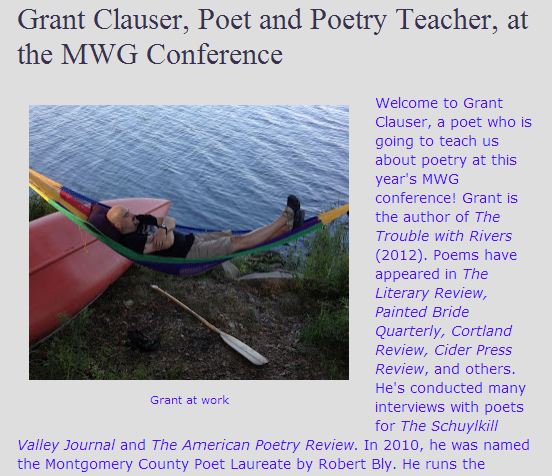 In April I’m traveling to Missouri for the 2013 Missouri Writers’ Conference. I’ll be teaching two sessions there, a one-hour session called Core Issues and a longer, three hour, session called Building Trustworthy Poems. You can learn more about and register for the conference here.
To help promote the confernence, Margo Dill conducted an interview, which you can see here.
These two videos were recorded at a Mad Poets’ Society event in Media PA in 2012.
More about Harry Humes here.

One of American’s most beautiful poets, Jack Gilbert, has passed away. He was 87. He is easily the most important poet to me as a reader and as a writer.
WAKING AT NIGHT
The blue river is gray at morning
and evening. There is twilight
at dawn and dusk. I lie in the dark
wondering if this quiet in me now
is a beginning or an end.
(from The Dance Most of All)
Some links below:
Page on Gilbert by the Academy of American Poets
Notes from a Poet’s Well-Observed Life (NPR)
Chard deNiord’s interview with Jack Gilbert.
David Orr’s review of Gilbert’s Collected Poems
LA Times feature on Jack Gilbert
Poetry Foundation page on Gilbert
When writing, I keep to a handful of rules, something to guide my work, like a handrail on a woods trail. I also have a tendency to change my rules when they no longer suite me. Here are today’s, which may be different from tomorrow’s:
 Donald Hall recently wrote some observations on the ubiquitous poetry reading for The New Yorker. I won’t summarize it for you—read it for yourself here. It’s long, but worth your time.
It also got me thinking about all the readings I’ve done and attended.
I’ve been doing a lot of readings the past two years. Some sprung from an award I won. The award apparently got my name out to a few people I didn’t know previously (which is easy, because I know hardly anyone). Then early this year my first book came out, so I actively courted readings in the hope of selling books (sometimes it worked, sometimes not). When I’m not doing readings (which is most of the time) I try to attend as many as my schedule allows. Here I attempt my random observations on poetry readings.
***
My first “real” poetry reading was (I think) D. Nurkse at Bucknell University in the mid-80s. I was a student at nearby Bloomsburg University, and one of my literature professors, who I occasionally drank with, took me to the reading. Around the same time I also heard Harry Humes there. It may even have been the same reading. Not sure. Either way, I got some books signed.
***
Since I go to a lot of readings I have a lot of signed books. Most poets try to write something nice (“thanks for the support…”). At that first reading, Nurkse just wrote his name at the top of the page like he was signing a math exam. After a reading at Bucks County Community College in the early 90s, where I was teaching at the time, Jack Gilbert not only signed, but also drew a little picture in my copy of The Great Fires. I try to write something funny, but often just scribble so people assume it says something funny.
***
As Hall notes in his post, many poets butcher or drown their poems at public readings. That’s why I have trouble remembering so many of the readings I’ve attended. Jack Gilbert was quiet, but he had a seriousness to his reading as if he was re-experiencing the poem in front of us. Thomas Lux punches his poems out like a nail gun. Robert Hass–I know I saw him in Philadelphia, but have no memory of what it was like.
***
Robert Bly often repeats himself at readings (not in the same way my grandmother used to repeat herself). He seems to truly enjoy the process of reading aloud, and when he comes to a line he likes (or thinks you should like) he says it again. Sometimes that means he reads the whole poem again just because he enjoys doing it. I like that, though I wouldn’t try it myself. You’d just call me insufferable.
***
I don’t know if I’m a good reader. I read my poems out loud all the time—as I’m writing, revising or just reading my poems over again. I walk around the house at night doing that. I’m not sure what my poems should sound like or what I should sound like. I recently had one audience member complement me on my reading style, and at the same reading another person asked me why I read my poems “like that.” I’m not sure what “that” meant. My wife says I hunch over when I’m reading.
***
I envy people who have a strong reading voice–like a radio voice. Southern poets have a clear advantage. A southern accent makes any line sound cooler. I don’t think a southerner ever said that about a Yankee accent.
***
I have a personal rule: At every poetry reading I must buy at least one book (if books are for sale). If no books are for sale, then I at least buy something from the host venue (coffee, beer, muffin, whatever…). I’m always shocked when I see a crowd of 30 people show up for a free reading, and the poet only sells 3 books. That’s shameful. Books are cheap, and we need to support each other. I’ve been that poet. I once drove more than two hours for a venue where I was invited to be the featured reader. Only about 10 people showed up. One bought a book. The venue complained that I brought in my own bottle of water (I’d just come in from a pizza place), made me throw it out and buy another bottle of water there. Remember, most poets are unpaid for readings. Selling a few book copies is all we’ve got to pay for the gas and pizza.
***
At that reading I traded a copy of my book with another poet for his book. Trading books with other poets is cool. I do that whenever I can. Also, if you like the reading, offer to buy the poet a beer, especially if it’s me.
***
Should poets be paid for readings? If you’re Donald Hall, then of course you get paid. I’ve been paid about four times in my life for readings. One was a public library. Once was at a university, and it paid nicely (and included dinner). If you work at a University, please invite me to read. I’ll be gracious.
***
At most readings, the host or venue treats the visiting poet very nicely, but there have been times… At a reading I did in Skippack (at a coffee shop that no longer exists), I got the impression that my presence was an inconvenience to the manager even though I was invited. The shop didn’t want to move any seats to accommodate a reading, didn’t want me to read too long because a guitar player was coming later that evening, and I was expected to pay for my one cup of coffee. Luckily, only about three people came.
***
Sometimes you can tell when half the audience is only there for the open reading after the featured poet. They spend the whole time heads down, shuffling through their own papers, tapping on a phone… then jump up for the open period. Those people suck.
***
When a host says you get 15 minutes or 30 minutes or whatever, does that mean you automatically get an extra 10-20 percent extension? I seem to see that a lot. Sometimes I mind. Sometimes I don’t. Usually the times I mind are when I’m last in line out of a series of readers and find out that now I’ve only got 4 minutes because we’re out of time.
***
Applause. People should know by now that they don’t need to clap after every poem. Maybe an occasional spontaneous burst, but not EVERY poem. Save the applause to the end.
***
I admit that my mind wanders during poetry readings. Unless the presentation is especially engaging (or it’s Donald Hall), I sometimes have trouble focusing, especially on long poems. Maybe that’s why I don’t write long poems. If any of you out there see that look in my eye while you’re reading, I’m sorry.
***
At a reading at an art gallery I was impressed with how closely the audience was paying attention. Their eyes never seemed to waver from me at the front of the room. After the reading I realized that behind me were two life-size nude portraits , one of a lovely women and one of a very interested man.
***
Sometimes I wonder why no one wants to sit in the first row when I’m reading. I don’t think I spray when I speak. Lately I’ve been trying to sit up front so I get a better view for taking videos with my phone.
***
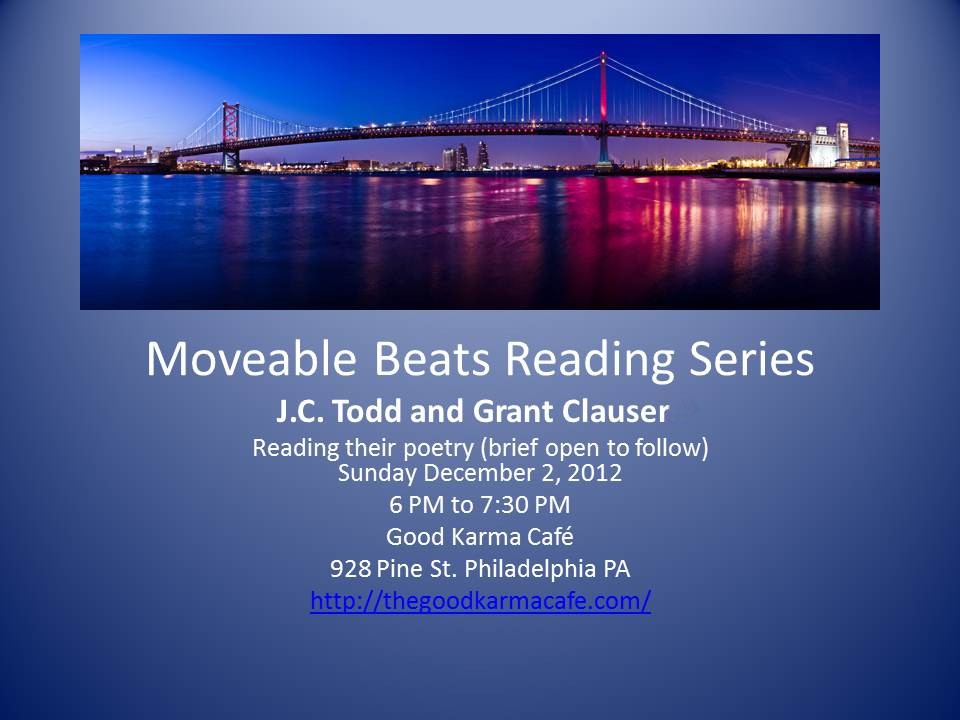
It’s late, and I’ve run out of ideas. Please add your own thoughts to this. If you want to hear me read, I’ll be at the Good Karma Cafe on Dec 2 with J.C. Todd.
Yesterday I had the pleasure of joining a fantastic group of poets reading at the 25th annual (wow–25 years) Mad Poets Festival in Media PA. An impressive crowd of poets attended and read, including Joseph Farley, Leonard Gontarek (and his teenage son Max), David Kozinski, Allison Hicks, Peter Krock (editor of the Schuylkill Valley Journal) and many more.
A highlight for me was seeing Daniel Hoffman, the nation’s first Poet Laureate (before the title had that name) and winner of the National Book Award. He’s 89 years old,turning 90 very soon, and read a poem about that at the festival (see video below). I mentioned to him before the reading that I’d recently been reading his book The Center of Attention and was actively stealing ideas from it. His 14th book of poems is soon to be released.
 Grant Clauser